

In a nutshell: In this playbook, Cloud Humans amplified its founders’ posts with LinkedIn Ads reach campaigns aimed at 7,800 ICP decision-makers. With R$5,000 (about US$900) over 30 days and frequency per account as the north-star metric (target: 8 exposures), they got 93 hand-raisers, 62% from companies that had never entered the funnel. Warm outbound was then switched on for accounts above 8 exposures.
This playbook was born from a simple (and stubborn) experiment: if founder-led growth already attracts organic demand, what happens when I layer ultra-selective paid distribution on top (only on ICP accounts) to make sure the right message hits the right decision-makers, over and over?
I’m Claudio from Cloud Humans, and the hypothesis I posted on LinkedIn recently (“founder-led works; founder-led with Ads works WAY better”) came from friction I felt every day: posts from Ian and Cecatto (our founders) made noise and often got hands raised, but I didn’t control who saw them, how often, or in which buying window. The content side was in great shape; what was missing was a distribution flywheel that organic, by definition, can’t give you.
This post is me opening the books. I’ll show you what worked and what didn’t, why I chose reach over clicks, how I trigger warm outbound when frequency climbs and which numbers I consider enough to say “there’s a real effect here”.
Let’s dive in.
Diagnosis: organic alone doesn’t add up
Ian’s and Cecatto’s posts were already driving solid demand. People trust founders talking about the market, behind-the-scenes stuff and tough calls. DMs came in, comments, referrals. The authority effect is real, and I’m not giving it up.
Even with good content, I didn’t control the two things that decide the game: exactly who was seeing it and when. Sometimes the right decision-maker saw the post in the wrong month. Sometimes a post blew up, but outside the ICP bubble. The result: great conversations, and a pipeline that was more unpredictable than I wanted.
I wanted my ICP accounts to see the right story several times in the same month. I wanted “Cloud Humans” to become a mental shortcut for “solving CX efficiently”. I wanted to put the conversation in the feed of the people who sign the budget and run the operation. You don’t solve that with more posts. You solve it with precise distribution, controlled frequency and account-level reading, not vanity impression totals.
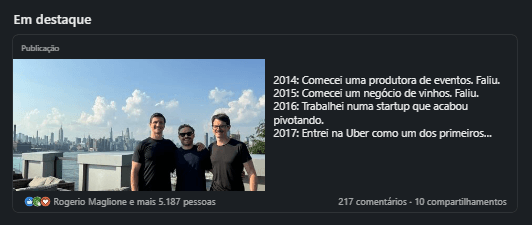
I plugged Ads in exactly where organic was strong: I took founder posts that already had engagement and used them as creatives. None of that traditional “contact us” creative. Posts that look like posts.
The difference is that with Ads, I chose who would see them and how many times that month. I went from “hoping the algorithm helps” to “guaranteeing presence in the accounts that matter”.
Strategy: the mental availability thesis
I don’t buy clicks. I build recall.
The strategy is easy to say and demanding to execute: use the founders’ content as a vehicle of trust and use LinkedIn Ads to make sure that message shows up again and again, in the same month, inside ICP accounts.
When the right person sees us again, and again, and again, they don’t need to click the ad to act. They remember the name. They recognize the story. They reply when I reach out. That deliberate repetition is what turns posts into pipeline.
The yardstick for everything is frequency per account. Not total impressions, not CTR, not cost per click. I look at how many times, over thirty days, each account in my ICP was exposed to my creatives. I work with ranges because they become operating triggers.
Under three is noise. Between three and eight, it starts to stick. From eight up, I feel sales opening up. Above twelve, it’s close to omnipresence.
In my pilot, I went in aiming for a frequency of eight on priority accounts, and that’s exactly where the conversation started to flow. When that number rises in the right accounts, everything else shows up as an echo: more hand-raisers, more outbound replies, more inbound conversions saying “saw a post from Ian” in the “how did you hear about us” field.
ICP and account list
If I get the list wrong, everything else becomes expensive noise. The ICP isn’t a pretty slide; it’s a living slice of companies and people with a real CX problem to solve right now.
I started with what was in my own backyard: lost opportunities that still made sense and qualified accounts that had never talked to sales. That was in the CRM, not in a brainstorm. I removed active customers, cut competitors, standardized company names and domains. I wanted to look at that spreadsheet and feel that, if I hit play, I’d be showing up in the feeds of the people who actually decide.
My ICP criteria
My buyer isn’t “all of LinkedIn”. It’s the committee that buys and runs CX.
In practice, I prioritized Heads of CX, operations leaders and a C-level with signing power. If I loosen that up, I waste frequency on people with no decision power and end up fooling myself with pretty numbers that never turn into meetings.
I’d rather lose volume and gain impact. Mental availability is only worth something when it happens in the head of someone who can turn recall into a calendar invite.
From theory to spreadsheet
I pulled the CRM export, normalized company names, kept subsidiaries as separate accounts when they had their own decision-making power and created a unique ID per account. That gave me a base to enrich without messing up matching.
The goal was simple and demanding at the same time: get to an audience big enough to allow repetition over the month and small enough to keep ICP precision. After cleanup, I moved on to enrichment.
Enrichment that matters
I opened Apollo to bulk-enrich contacts: name, job title, seniority and LinkedIn profile. CX, operations and C-level decision-makers. No shortcuts. I removed duplicates by email and LinkedIn URL, fixed ambiguous names and matched contact columns to the parent account.
It sounds boring, but this is where I make sure the frequency I’ll measure later is the decision-maker’s frequency, not the intern’s. In the end, I closed the file with 7,800 contacts. To me, that number feels safe. It gives scale without forcing me to dilute the audience with expansion. And it fits our value prop without forcing it.
Message and creatives
If distribution is the flywheel, the message is the engine. I write to the pain the decision-maker is feeling right now, not to my offer. Scaling CX without doubling headcount, reducing friction at tier 1, getting the team out of firefighting mode and putting energy where it moves the target.
When I start with the pain and move toward “the how”, people read without putting their guard up. Founder-led helps because founders have license to talk about the market and behind-the-scenes stuff candidly. I use that license to share choices, trade-offs, mistakes and fixes.
The sale shows up as the logical consequence of the story, not as a push. That’s what lets you repeat the message several times a month without seeming pushy. Repetition becomes familiarity. Familiarity becomes replies.
A format the feed accepts
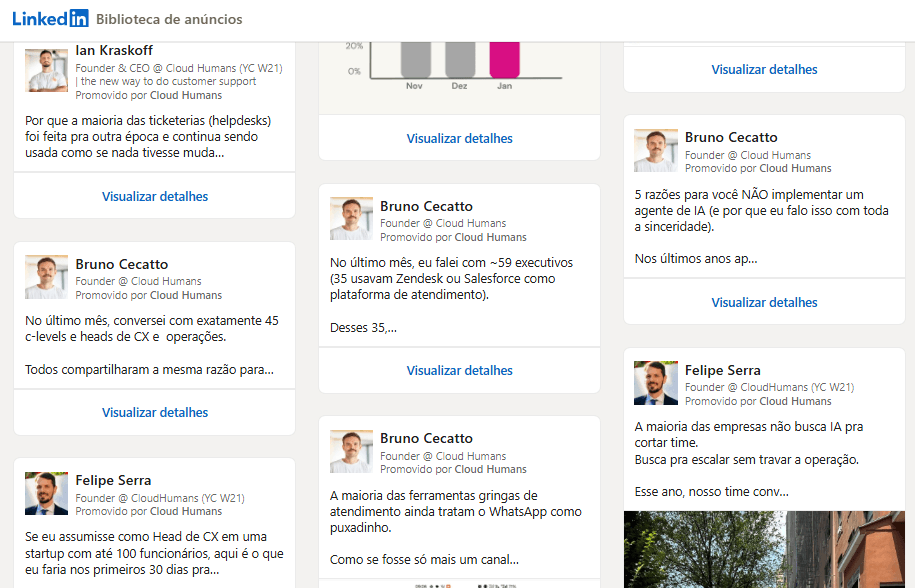
On LinkedIn, anything that looks like an ad dies on the first scroll. My creative has to be a post from Ian or Cecatto, with a conversational rhythm, eye-to-eye, a behind-the-scenes screenshot, a short captioned video you can watch on mute.
I cut the fluff, swap “book a demo” for an honest invitation to think things through together and leave the CTA implied. When the piece respects the feed, it inherits the social effect of organic. People don’t just see it; they recognize the voice. And that “I already know you” feeling is gold once frequency starts climbing.
How I picked and adapted the material
I didn’t invent topics in a meeting. I went to what the market had already validated organically. I took posts that got dozens of saves and comments, picked snippets of public conversations with customers, pulled product lessons that tied straight into CX pains and brought them to LinkedIn Ads with as little editing as possible.
I kept the headline and the tone, just a few tweaks so a cold audience could follow without prior context.
Signs of fatigue and switching angles
Careless repetition turns into fatigue. I watch view time, CTR and reading depth. If frequency goes up and consumption drops, it’s time to switch angles without betraying the story.
Instead of talking about operational efficiency, I lean into team health. Instead of product behind-the-scenes, I bring a market view. Same story, different focus. That rotation keeps frequency healthy and stops the audience from building up “antibodies”.
Pilot results
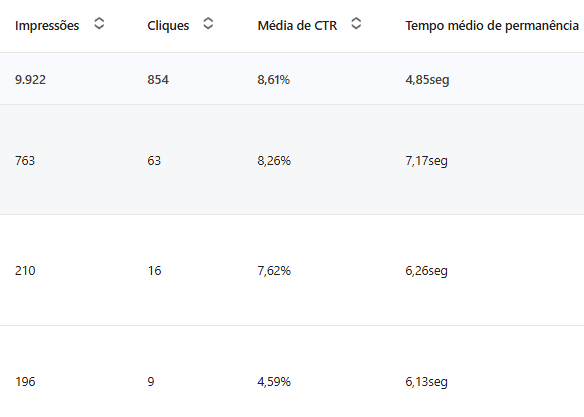
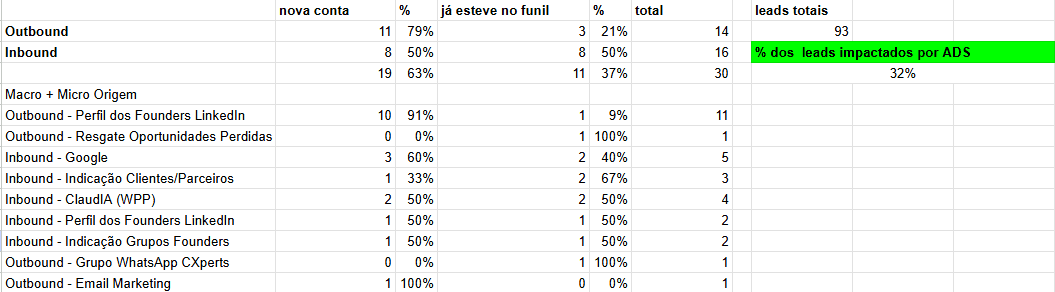
I ran 30 days of reach campaigns on LinkedIn Ads: a R$5,000 budget (about US$900) and an audience of 7,800 ICP contacts. My yardstick was frequency per account. In that period, 93 hands were raised.
- Of those, 31% came from accounts that saw our creatives at least 3 times that month; some accounts hit 40+ exposures.
- On top of that, 62% of the hand-raisers came from companies that had never been in our funnel.
- Among the “new” ones, 79% came in through outbound, which confirms the effect I was after: the authority built by the founders shortens the response when I knock on the door.
- Overall, about half of the 93 hand-raisers came inbound. A sign the brand was alive in the audience’s head, even without clicks.
One important detail to read these numbers honestly: that month, I didn’t run any dedicated outbound cadence for the LinkedIn Ads lists.
The only outbound was a simple social selling trigger: engaged with the post, got a LinkedIn message.
There were also no direct conversions from the ads, and that was on purpose. The ad’s job here was to create repetition and memory; action came through view-through, organic touches and light outbound.
Warm outbound
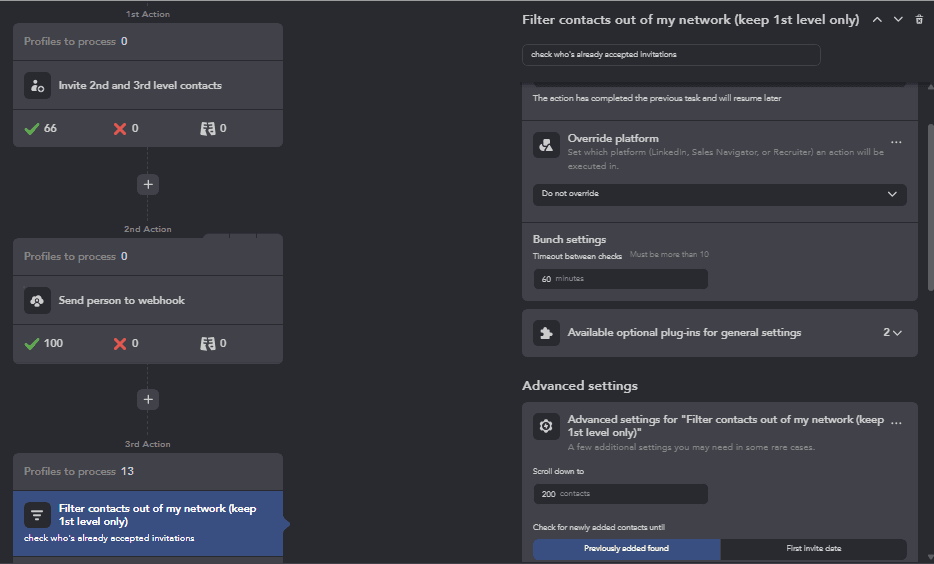
After that period, I prioritized 582 new accounts with frequency above eight and kicked off a “warm cadence”, or warm outbound. Four profiles (all founders) ran it through LinkedHelper to split the load and respect daily limits.
From that cohort, I reached out to 999 contacts and got 21 hand-raisers, with 5 opportunities created. Contact → hand-raiser conversion: 2%.
For re-engaging lost opportunities, I reached out to 210 contacts, got 7 hand-raisers and, so far, no open opportunities. Contact → hand-raiser conversion: 3%.
The cadence is still running. Around 30% of the list hasn’t received all three messages yet, so I expect a decent bump once the window closes.
Lessons I’m taking with me
I got the cohort size wrong. I tried to take on the world and paid for it with long cadences: what should’ve taken five business days took almost three times as long, because of limits and even some shortcomings in LinkedHelper itself.
On top of that, two profiles got temporarily restricted for suspicious activity. And not even for bulk actions, but because two IPs from different locations were accessing the account at the same time (the real account owner and the Helper).
On the other hand, I’ll admit I expected a higher conversion rate from the cadences, especially from lost opportunities. I got skeptical of LinkedIn-only automation and I’m already looking into a multichannel tool that combines LinkedIn and email in the same cadence (Lemlist).
I’m also changing the order of one step that makes all the difference: before any message, I want to send the whole list as connection requests from the founders. Ian and Cecatto opening the door speeds up the first conversation and makes everything feel more “natural”. That also fixes the long cadence problem with the Helper.
To wrap up, a side effect I loved: our community, CXperts, jumped from 400 to 467 members in that period. Some people preferred joining the community before talking to sales. The invite was the last message in the cadence. Silver lining: the lead stays in my circle and keeps getting nurtured.
The “do it now” checklist
- List your ICP accounts (ideally, open your CRM and start with lost opportunities and qualified accounts that never talked to sales).
- Enrich the contacts at those accounts with Apollo or similar, so you get a high match rate when you upload them to LinkedIn Ads.
- Pick 3 to 5 founder or customer posts with good engagement and adapt the copy without losing that “feed vibe”. I like adding key links at the end, like in-depth content and the product page.
- Launch a reach campaign on LinkedIn with company and contact lists, no audience expansion.
- Set your monthly success bar by frequency ranges: 3+, 8+, 12+.
- Review every two weeks frequency by campaign and account, and adjust audience and budget.
- When an account crosses a frequency of eight in the month, trigger warm outbound.
- Recycle what worked in paid into organic, and bring what shined in organic into paid.
- Document lessons, risks and setup changes every cycle so you don’t depend on memory.
Want the strategy side in more detail? Read how to generate demand with Founder-Led Growth + LinkedIn Ads.
Extra proof to make the playbook bulletproof
I’m going to run three simple, powerful validations.
The first is a holdout: set aside a slice of the ICP with no exposure and compare reply rate, hand-raisers, branded search and time-to-meeting against the exposed cohort.
The second is the frequency vs. response curve: plot average frequency per account against outbound reply rate and hand-raiser volume to find the sweet spot. In my case, eight is where I think things open up.
The third is share of search: tracking branded searches during the campaign window, because it’s an honest proxy for recall “outside my own garden”.
With those three layers, I move the conversation from “trust me” to “look what happens when the right message shows up again and again for the right people”.
If you made it this far, you’ve got enough to set up your first round. Start small, stay precise, protect the post aesthetic, read frequency per account calmly and only then hit the gas on sales.
When the content flywheel and the distribution flywheel spin together, your brand becomes impossible to ignore. That’s exactly when the pipeline starts to feel light.
Frequently asked questions
What metric drove the Founder-Led Growth pilot?
Frequency per account: how many times each ICP account saw the creatives in 30 days. Under 3 is noise, 3 to 8 is where it starts to stick and above 8 sales start to open up.
How much was spent and what were the results?
R$5,000 (about US$900) over 30 days of reach campaigns to 7,800 contacts, generating 93 hand-raisers, about half of them inbound.
Why a reach campaign instead of clicks?
Because the goal was building recall in the right accounts. Action came through view-through, organic touches and light outbound.
When should you turn on warm outbound?
When an account crosses a frequency of 8 in the month. In the pilot, 582 new accounts in that range went into the warm cadence.