
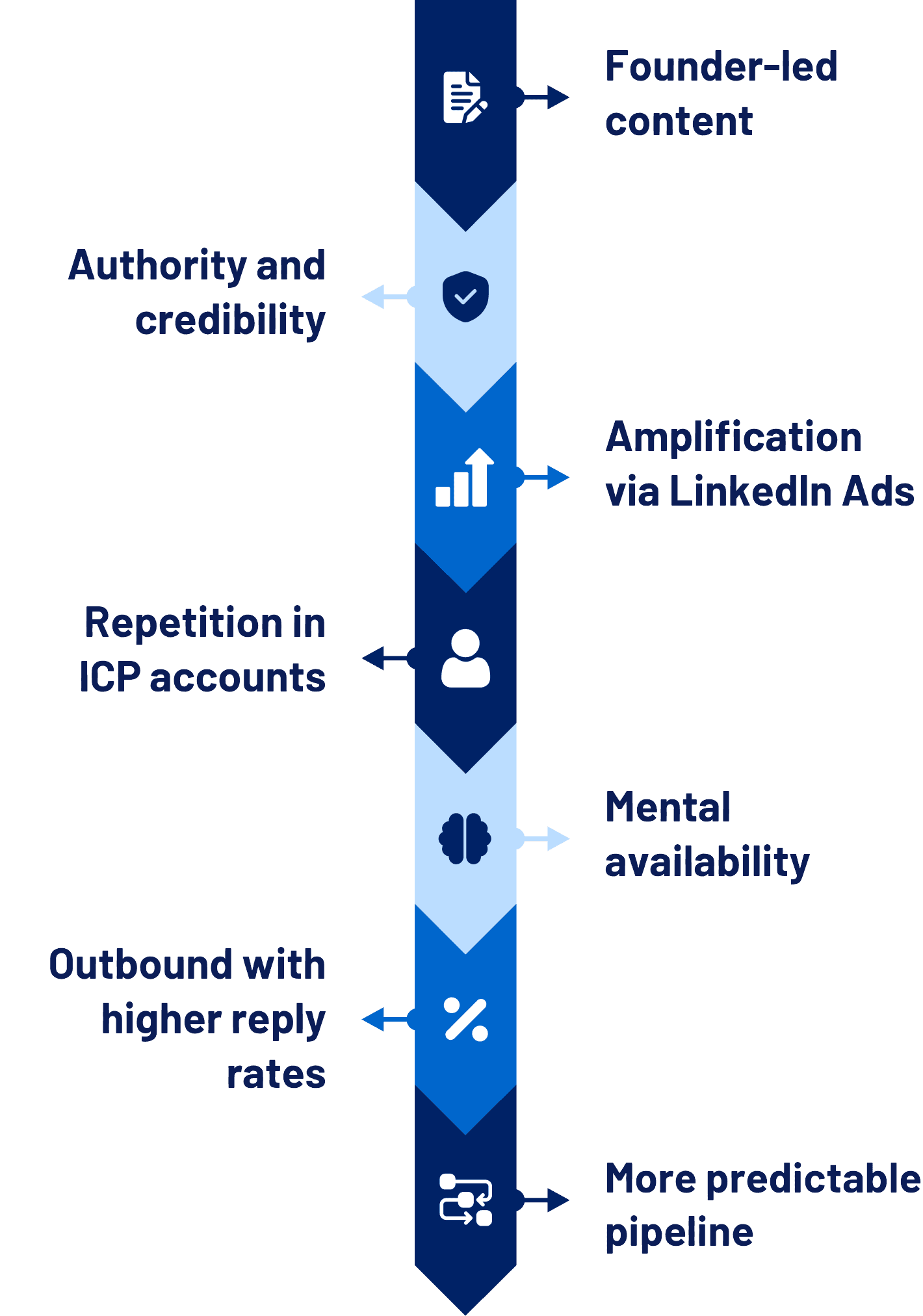
In a nutshell: Founder-Led Growth plus LinkedIn Ads works like this: executives post content with a real point of view, the best-performing posts get amplified with paid media only to your ICP accounts, and exposure frequency (ideally 6 to 8 impressions per decision-maker) builds mental availability. Once frequency climbs, outbound stops feeling cold.
Most B2B companies already get that LinkedIn drives visibility. The problem is that visibility doesn’t necessarily mean predictable demand generation.
Organic posts can do really well: comments, shares, even a few DMs. But organic has a built-in limit: you don’t control who sees your content, when they see it or how many times.
That’s exactly where an approach more and more fast-growing B2B companies are adopting comes in: combining Founder-Led Growth with selectively distributed LinkedIn Ads.
The logic is simple but powerful:
- executives build authority and a story on LinkedIn
- high-credibility content gets amplified with paid media
- distribution focuses only on your ICP accounts
The goal isn’t necessarily more clicks. It’s something else: building mental availability inside the right accounts.
This article shows you how to set up this strategy in a repeatable way, from defining your ICP all the way to turning on warm outbound. Let’s go!
The limits of organic content for B2B demand generation
Executive-led content usually outperforms corporate content.
That’s because the market tends to trust people more than brands.
When founders or executives share:
- lessons from the market
- strategic decisions
- behind-the-scenes product stories
- mistakes and course corrections
the content gains credibility and closeness.
But even with great content, two things stay out of your control:
- Who is seeing the content
- How many times that person has seen the message
In complex sales, that makes all the difference.
A decision-maker might see a great post at the wrong time. Or a post might go viral, but outside your ideal audience.
That leads to interesting conversations, but it makes your pipeline unpredictable.
The logic behind the strategy
The core idea of this model comes from the theory of mental availability, a hot topic in strategic marketing.
Put simply:
brands that show up again and again in the right context are more likely to be remembered when a need comes up.
In B2B, that means when a relevant problem pops up, the decision-maker automatically thinks: “Company X solves that.”
That kind of recall rarely comes from a single exposure. It’s built through repetition.
That’s exactly why campaigns focused only on clicks or direct lead gen often miss the real impact of the strategy.
Here, the main metric isn’t just CTR. It’s exposure frequency within your ICP accounts.
Where LinkedIn Ads fits in
LinkedIn Ads works as a distribution flywheel for authority content.
The idea isn’t to create traditional ads, but to amplify real posts from executives.
That means:
- posts written in natural language
- native feed format
- a personal story
- market insights
When you boost this content selectively, the result is different from traditional ads.
It still feels organic, but now it shows up again and again in the feeds of key decision-makers.
Defining your ICP and account list
If the strategy depends on repetition inside strategic accounts, list quality is critical.
A common mistake is going too broad. When that happens, frequency gets diluted.
The sweet spot is a highly qualified ICP.
Some common criteria to consider:
- market segment
- company size
- operational maturity
- specific teams in place (CX, operations, technology, etc.)
It’s also important to map the relevant decision-makers inside those companies.
Keep an eye on roles like:
- operations leaders
- department heads
- directors
- C-level
Data enrichment tools can help you build the list.
Some of the most popular are Apollo, Clay, ZoomInfo and Cognism, among others.
The goal is a list of real decision-makers, not just anyone who works at the company. (Our LinkedIn Ads for ABM guide goes deeper on this.)
How to pick the right content to amplify
Another common mistake is trying to create brand-new ads for paid media. Most of the time, your best creative already exists in organic.
The most efficient path is usually:
- look at posts with high engagement
- find content with lots of saves or comments
- tweak it slightly for a cold audience
The formats that tend to work best:
- takes on the market
- lessons from customers
- behind-the-scenes product stories
- strategic decisions
The secret is keeping that “feed vibe”. The more a post looks like an ad, the lower retention tends to be.
The main metric: frequency
In B2B demand generation, one of the most underrated metrics is exposure frequency.
A practical way to work with it is to set operating ranges.
For example:
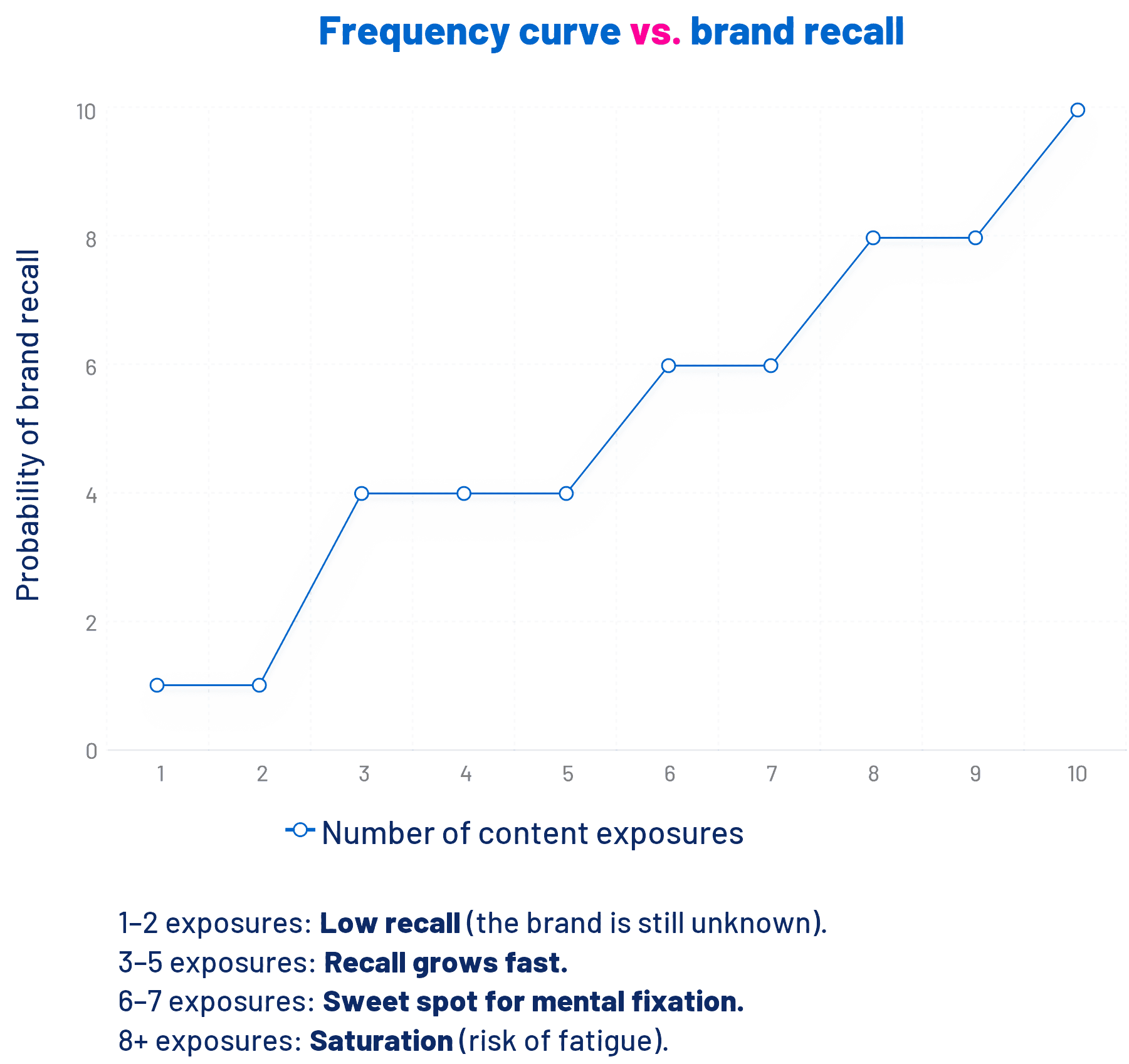
- 1 to 2 exposures: still too few
- 3 to 5 exposures: recognition starts
- 6 to 8 exposures: the message starts to stick
- 8+ exposures: the brand starts being remembered
That frequency doesn’t have to come from the same post; it can come from a mix of different content.
What matters is keeping a consistent story.
👉 Heads up: the same ad at a very high frequency can saturate and wear out your audience. Hit a frequency above 7 or 8? Line up fresh content!
The right moment to turn on warm outbound
When frequency starts climbing inside your strategic accounts, something interesting happens.
The market has already come across your story.
Your executives have already shown up in their feed.
Your brand is already recognized.
That completely changes how people respond to outbound, because cold messages stop feeling cold.
This model is often called warm outbound.
In practice, it works like this:
- connect on LinkedIn
- engage with their posts
- send contextual messages
- invite them to exploratory conversations
The difference is that the outreach doesn’t come out of nowhere. It comes after a series of indirect exposures.
The role of executive authority in demand generation
Another critical piece of this strategy is the executive.
Content from founders, directors or in-house experts has a very different impact than corporate content.
It carries:
- real experience
- a view of the market
- actual decision-making
Over time, these executives stop being just company spokespeople and become go-to references in the market.
That shift is what separates a simple content strategy from a broader corporate influence movement.
Executives who build authority on LinkedIn end up becoming strategic assets for new business, especially in B2B markets where trust and reputation are make-or-break.
Key lessons from putting this strategy to work
A few lessons come up again and again when companies start using this model.
First: precision beats volume. A smaller list of the right accounts usually beats broad audiences.
Second: content needs to feel human. Overly salesy posts tend to underperform in the feed.
Third: repetition matters. Most companies pull the plug on campaigns before the message actually sticks.
And fourth: content and distribution have to work together.
Without relevant content, there’s no story.
Without strategic distribution, the story never reaches the right people.
Founder-Led Growth: a practical checklist to get started
To set up the first cycle of this strategy, a few steps are essential:
- ✅ Define your ICP precisely (map the companies that actually have buying potential).
- ✅ Build a list of strategic accounts (ideally based on CRM data).
- ✅ Map the decision-makers inside those companies (the roles with real buying power).
- ✅ Pick organic content that performed well (especially executive posts).
- ✅ Amplify that content with LinkedIn Ads (using reach campaigns).
- ✅ Track exposure frequency in your priority accounts.
- ✅ Turn on outbound once frequency hits meaningful levels.
Want the full playbook? Check out our Founder-Led Growth playbook.
Why this approach is gaining ground in B2B
B2B marketing has changed a lot in the last few years.
Decision-makers are more and more:
- informed
- skeptical of traditional ads
- influenced by experts and industry leaders
In that context, strategies that combine authority, content and smart distribution tend to deliver more consistent results.
Founder-Led Growth amplifies credibility.
LinkedIn Ads guarantees presence in your strategic accounts.
And when the two work together, something important happens: your brand stops competing for attention only at the moment of purchase.
It starts owning a constant spot in the market’s mind.
Frequently asked questions
What is Founder-Led Growth?
It’s a strategy where founders and executives lead demand generation with their own content, using their credibility to pull the market in.
Why amplify executive posts with LinkedIn Ads?
Because organically you don’t control who sees your content or how often. Paid media guarantees repetition inside the right accounts.
What’s the ideal exposure frequency?
Around 6 to 8 exposures is when the message starts to stick. Past 7 or 8 on the same ad, refresh your creatives to avoid fatigue.
When should you turn on outbound?
Once exposure frequency in your priority accounts reaches meaningful levels. That’s when your messages stop feeling cold.