In a nutshell: LinkedIn Ads is the most precise paid channel for reaching B2B decision-makers: you target by job title, company, industry and seniority. It shines for complex, high-ticket sales when you run layered campaigns (top, middle and bottom of the funnel) and measure pipeline, not just CPL.
If you work in B2B marketing, you’ve probably heard that LinkedIn Ads is the place to be if you want real results from paid media.
But here’s the thing: the game on LinkedIn is totally different from the platforms you already know, like Meta or Google.
In this Complete LinkedIn Ads Guide (2026), we’ll walk you through exactly how to build campaigns that actually create demand, open doors for your sales team and turn LinkedIn into an opportunity machine.
Who is LinkedIn Ads for?
First things first: LinkedIn has become the place for professional, strategic, big-money decisions. That’s why it tends to work best for companies that sell through relationships, trust and authority.
B2B companies
LinkedIn Ads is especially powerful for B2B companies dealing with:
- Complex sales and longer buying cycles (6 months or more).
- Mid-to-high ticket deals (roughly $10K a year or more).
- Multiple decision-makers involved in the purchase.
Industries like tech and SaaS, professional services, consulting, executive education and manufacturing usually see great results here.
What about high-ticket B2C?
Even though the focus is B2B, LinkedIn also works for B2C when the purchase isn’t an impulse buy and takes research and trust. Think mentoring programs, career coaching, luxury real estate and high-end financial services.
👉 The truth about low-ticket B2C: most of the time, it’s not worth it. LinkedIn isn’t built for quick consumer purchases. For that kind of offer, other networks will give you way more bang for your buck.
Why advertise on LinkedIn?
LinkedIn is way more than a professional social network. For anyone in B2B sales and marketing, it’s a goldmine of data.
The magic isn’t in what people searched for or liked, but in what they do: their job title, the company they work for and their skills. And that changes everything.
- Laser-focused targeting: imagine running ads only for marketing directors at SaaS companies with 200+ employees. On LinkedIn, that’s not a dream, it’s Tuesday. You reach the people who actually matter.
- A professional, focused environment: people are on LinkedIn with a business mindset. Their attention is far more qualified for your message.
- The go-to channel for ABM (Account-Based Marketing): with Matched Audiences and company list uploads, you can run hyper-targeted campaigns.
- High intent: people who engage with in-depth content on LinkedIn are usually in a learning or consideration phase, open to being educated and nurtured.
“But isn’t LinkedIn Ads expensive?”
Yep, cost per click (CPC) on LinkedIn can be 5 to 10 times higher than on Meta. But the right question isn’t “how much does it cost?”, it’s “how much is it worth to talk to the right decision-maker?“. Think about the value of a qualified lead who already fits your ICP (Ideal Customer Profile).
The classic LinkedIn Ads mistake
Lots of people treat LinkedIn like Google. They go straight for a bottom-of-funnel campaign with a cold demo offer and expect sales-ready leads. The result? Low conversion rates, sky-high CPL and, of course, a ton of frustration.
The reality: LinkedIn is a channel for attention and education. The real value is in building a relevant audience, nurturing it with valuable content, driving consideration and only then opening the door for sales. Qualified leads are the result of good work, not the starting point.
LinkedIn Ads for beginners: how to start the right way
Effective LinkedIn campaigns start way before you open Campaign Manager. You need a solid strategic foundation.
1. Nail down your campaign goal
Before anything else, ask yourself: what do you want to achieve?
- Lead generation? Use Lead Gen Forms or Conversation Ads.
- Qualified traffic? Run website visits campaigns.
- Positioning and authority? Invest in video and Thought Leadership Ads (boosting posts from your company’s spokespeople).
2. Understand the algorithm (and make it work for you)
In 2026, with AI everywhere, understanding the algorithm is key. Ads with a high CTR (above 1%) that spark engagement get a boost. Your account history matters too. In short: the more relevant your ads, the better your cost per result.
3. Structure your campaigns in layers
Pushing a bottom-of-funnel offer on people who’ve never heard of your brand is a recipe for disaster. Respect the buyer’s journey with a layered model:
| B2B sales funnel on LinkedIn Ads | ||
| Cold layer (TOFU – Top of Funnel) | Warm layer (MOFU – Middle of Funnel) | Hot layer (BOFU – Bottom of Funnel) |
| The goal is awareness through educational content (short videos, insight carousels, market studies). Focus on qualified reach and view time. | The goal is deeper engagement with high-value lead magnets (checklists, templates, webinars). This is where you start measuring CPL and conversion rate. | Time to turn intent into action with direct offers (demos, trials, Conversation Ads). Focus on qualified leads and pipeline generated. |
How LinkedIn Ads targeting works
Knowing how to advertise on LinkedIn the right way comes down to smart targeting. There’s no room for guesswork here.
Best practices for sharp targeting:
- Combine filters with “AND” logic: for example, “Director AND Marketing AND Company size > 200 employees”.
- Use exclusions like crazy: exclude people who already converted, competitors and anyone outside your ICP.
- Watch out for broad “super titles”: one wrong exclusion can knock valuable profiles out of your audience.
- Turn off Audience Expansion: stay focused and don’t water down your budget.
💡 Beginner tip: small audiences aren’t a problem on LinkedIn. LinkedIn officially recommends 50,000+ members, but plenty of B2B strategies work better with smaller audiences of highly qualified professionals.
Thumb-stopping creatives
In the LinkedIn feed, attention is scarce. Your ads need to be magnetic.
Formats with the best return for B2B
- Lead Gen Forms: great for lead generation with minimal friction.
- Short videos: perfect for building authority and educating fast.
- Document Ads (PDF carousels): ideal for in-depth content and practical guides.
- Thought Leadership Ads: boost posts from your company’s executives to build authority.
The secret is less about the format and more about the story. According to MarketingProfs, 65% of B2B content is considered irrelevant by decision-makers. Skip the obvious!
💡 Bonus tip: use the LinkedIn Ad Library to “spy” on your competitors and get inspired (we break it down in our LinkedIn Ad Library guide).
Budget and bidding: how much and how to spend
LinkedIn Ads runs on an auction where your ad’s relevance plus your bid decides who wins. More relevant ads pay less over time.
If you’re just getting started
- Starting budget: start with $25 to $75 a day per campaign so the algorithm can learn.
- Create separate campaigns for each funnel layer: that way you can optimize budget per goal and see where your money performs best.
- Be patient: run campaigns for at least 2 weeks before making drastic changes.
If you already have some history
- Check your benchmarks: CPC, CTR, CPL, conversion rate. Figure out what works and what needs tweaking.
- Estimate your target CAC and how much you can pay per lead: get clear on what a customer is worth to your business and how much you can spend to win one.
- Model different scenarios: based on the number of accounts and your audience size, project different spend levels and expected results.
Want to go deeper? Check out our guides on how much LinkedIn Ads costs and how to set your LinkedIn Ads budget.
Landing pages and conversion
Most campaigns fail because of the landing page. Your LinkedIn ads can be perfect, but if the post-click experience is bad, all that effort goes down the drain.
Top landing page mistakes
- Slow pages: slow load equals high bounce. Nobody waits.
- Forms that go on forever: ask only for what you need. More fields, fewer conversions.
- Confusing copy with no clear value prop: visitors need to get what you offer and why they should fill out the form in seconds.
- No visible CTA and no social proof: what should people do next? Why should they trust you?
How to build high-converting landing pages
- Optimize for mobile: according to LinkedIn itself, around 80% of engagement on the platform happens on mobile. Your landing page has to be flawless on phones.
- Use social proof: customer logos, testimonials, results. They build credibility and trust.
- Kill the friction: be direct, clear and to the point. Remove anything that distracts from converting.
How to measure LinkedIn Ads results realistically
LinkedIn Ads performance goes way beyond CTR and CPL. To prove ROI and optimize your campaigns, you need to look at what really matters:
- Impressions on target accounts: how deep is your message getting into your ideal market?
- Engagement by job title/company: are your ads resonating with decision-makers?
- Completed video views: is your content holding attention?
- Companies that visited your site (even without converting): an interest signal your sales team can act on.
- Opportunities sourced or influenced in your CRM: the real impact of your campaigns on the sales pipeline.
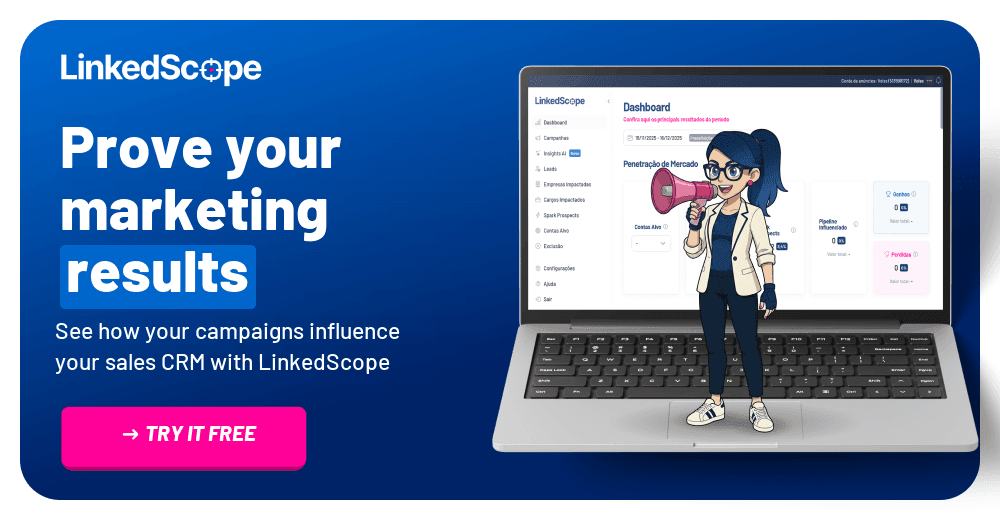
👉 With intelligence tools like LinkedScope, you can connect all this data and clearly show how paid media impacts your pipeline. It’s the best way to prove LinkedIn Ads ROI and justify your spend.
LinkedIn Ads trends for 2026
Digital marketing never stands still, and LinkedIn is no exception. For 2026, a few trends deserve your attention if you want to stay ahead:
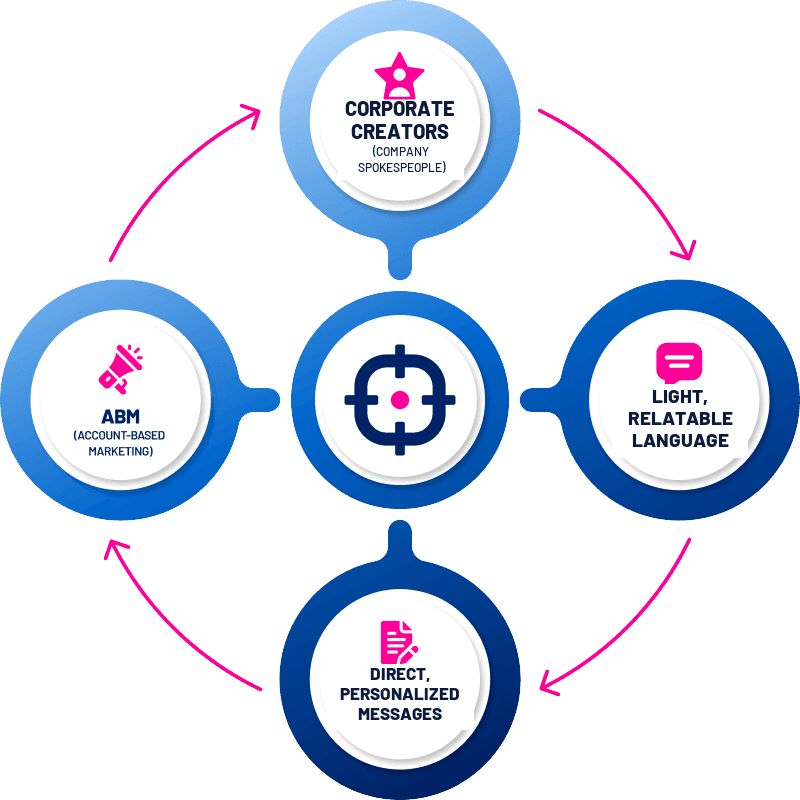
- Corporate creators and employee-generated content: authenticity keeps winning. Encourage your team to create relevant content and amplify it with ads.
- Ads with memes and internet-native language: stiff corporate speak is giving way to lighter, more relatable communication, even in B2B. Just use it wisely!
- Conversation Ads with hyper-personalized scripts: you know those LinkedIn messages that feel like a chat, where you pick from different reply buttons? That’s a Conversation Ad. In 2026, the trend is scripts that change based on each answer. Click “Show me pricing” and you get one path; click “Show me a case study” and you get another. It’s basically a mini chatbot guiding the buyer.
- ABM: Account-Based Marketing has leveled up. We used to target companies just by size or industry. Now, with AI, you can see which companies on your list are actively researching your problem right now (intent data). Instead of advertising to 100 companies, you focus your budget on the 10 that are “hot” right now. Learn more in our LinkedIn Ads for ABM guide.
Bottom line: LinkedIn Ads is about quality, not volume
LinkedIn Ads isn’t a volume channel. It’s a quality channel. It’s about penetration, brand building and direct access to decision-makers. If you want to scale opportunity generation the smart way, the path is clear:
- Relevant content that educates and engages.
- Well-targeted campaigns focused on your ICP.
- Creative creatives (yes, double dose!) that stop the scroll.
- Landing pages built to convert.
- Smart measurement that goes beyond vanity metrics and shows real pipeline impact.
And if you want to take the next step, trying a tool like LinkedScope can be a game changer. Think of it as the copilot for your campaigns: it shows which companies are “hot”, what the revenue impact was, and helps your team sell better and faster.
Ready to actually own LinkedIn? Where do you want LinkedIn Ads to take you in 2026? The answer is a well-executed strategy and constant optimization. Your move!
Frequently asked questions
Is LinkedIn Ads worth it for B2B?
Yes, especially if you sell complex, mid-to-high ticket deals with several decision-makers. Clicks cost more than on other networks, but you’re paying to reach the exact people who sign off on the purchase.
How much should I spend to get started?
A common starting point is $25 to $75 a day per campaign, running for at least two weeks before you make any big calls.
What’s the best LinkedIn ad format?
It depends on your goal: Lead Gen Forms for leads, short videos for authority, Document Ads for in-depth content and Thought Leadership Ads to amplify your executives.
How do I measure LinkedIn Ads results?
Go beyond CTR and CPL: track impressions on target accounts, engagement by job title, companies that visited your site and opportunities influenced in your CRM.