In a nutshell: LinkedIn Ads for ABM means using LinkedIn’s company and job title targeting to reach a defined list of target accounts with stage-specific messages. The playbook: pick your level (one-to-one, one-to-few or one-to-many), build the list with CRM data and market signals, match formats to each account’s stage, size your creatives to your budget, measure account progression and connect everything to your CRM and sales team.
In B2B marketing, success comes down to talking to the right accounts, at the right time, with the right message. That’s where LinkedIn Ads for ABM (Account-Based Marketing) becomes a must.
In 2026, LinkedIn is still the #1 platform for ABM, with advanced targeting that lets you turn engagement into predictable pipeline.
Want to know how to kick off your campaign? Keep reading!
Why LinkedIn is a must for ABM campaigns
Before we talk about LinkedIn, let’s get one thing straight: ABM isn’t a lead generation strategy. It’s a revenue strategy built around accounts.
In practice, that means moving away from the traditional model of:
- Attracting volume
- Qualifying leads
- Handing them to sales
And moving to a much more direct model:
- Define target accounts
- Engage the buying committee
- Accelerate opportunities
You’re not waiting for demand anymore. You’re creating demand in the right accounts.
And that’s exactly why LinkedIn beats every other channel. It’s the only place where you can, all at once:
- Find specific companies
- Reach decision-makers and influencers
- Control the message by account stage
- Plug in your CRM lists
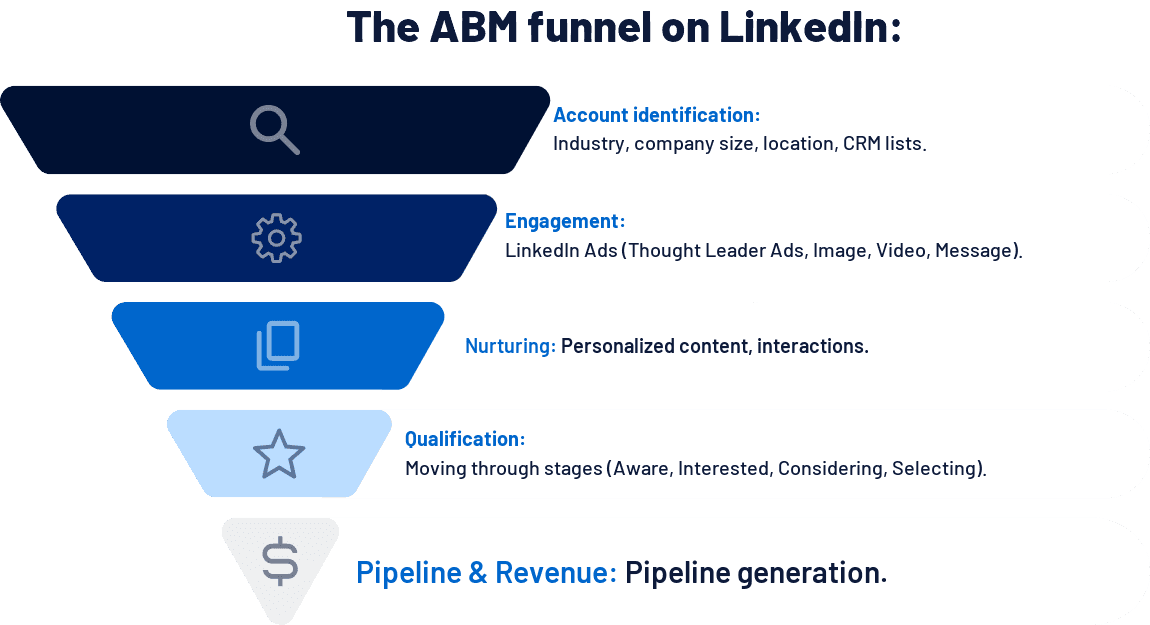
How to plan an ABM strategy on LinkedIn Ads
Before you create any ads, you need to decide how personalized your ABM strategy will be, because that changes everything.
One-to-one, one-to-few and one-to-many
One-to-one is ultra-personalized: each account is treated as a market of its own. It works for strategic, high-ticket accounts, but it doesn’t scale.
One-to-few is the sweet spot: clusters of similar accounts get specific campaigns, keeping things relevant without giving up scale. This is where most companies manage to build predictable pipeline on LinkedIn.
One-to-many is closer to traditional marketing: it drives awareness, but rarely moves complex accounts all the way to close on its own.
For example: a B2B software company with an average deal of $15,000 a year can hardly justify one-to-one campaigns for every account. But it can run one-to-few by vertical (one cluster of financial services accounts, another of retail) with different messages for each. On the other hand, a company with 5 strategic accounts worth $150,000 each should absolutely invest in one-to-one.
The secret is picking the model that fits your market reality, and there are clear criteria for that decision that go beyond list size.
How to build the right account list
Your account list is the foundation of everything. A poorly built list sinks the whole campaign, no matter how much you spend on creatives or targeting.
The criteria that really matter go beyond industry and company size. Technographic data, CRM history and market signals make all the difference when deciding which accounts deserve attention, and in what order.
A few examples:
- An HR tech company might prioritize accounts already using a competing ATS (a sign the problem it solves is already recognized).
- A logistics platform might focus on companies that grew more than 30% in the last two years (a sign they may be hitting operational bottlenecks).
- A fintech SaaS might filter for accounts that just raised a funding round (a sign they’re in buying mode).
Creatives and ad formats
Execution matters as much as planning. LinkedIn offers lots of formats, and the right choice depends on the account’s stage, your budget and each campaign’s goal.
Some examples of how this works in practice:
- An account that’s never heard of you benefits from a short video or a Thought Leader Ad that frames the problem, not a demo ad.
- An account that’s already clicked two or three of your ads is ready for a case study from a similar customer or a head-to-head comparison with the competitor it uses.
- An account with an identified decision-maker and recent engagement can get a direct Message Ad.
Running every format at once without this stage logic is one of the most common (and most expensive 💸) mistakes.
💡 The order in which you introduce each format matters as much as the format itself.
How to calculate and split your budget
One of the biggest mistakes in LinkedIn ABM campaigns is launching lots of ads on too little budget. The result: no creative gets enough data to be evaluated, and the campaign never actually learns.
There’s a simple formula to figure out the maximum number of ads you can run efficiently on your budget.
Example:
With an average CPC of $8 and a $5,000 monthly budget, the number is lower than most teams think. And understanding that limit completely changes how you structure your campaigns. (See the full math in our guide to setting your LinkedIn Ads budget.)
💡 Before you think about how many creatives to produce, figure out how many you can actually run. Budget defines the structure, not the other way around.
Campaign structure in LinkedIn Campaign Manager
How you organize your campaigns directly affects the quality of your engagement data and, therefore, your ability to spot intent by account.
There’s a structuring logic that cuts wasted budget, works around LinkedIn API limitations and makes sure the right accounts see the right message at the right time.
Naming conventions for ads and campaigns, for example, look like an operational detail, but they make a difference.
An ad called “img_awareness_retail_mar26” tells you way more than “campaign 3 – creative B”.
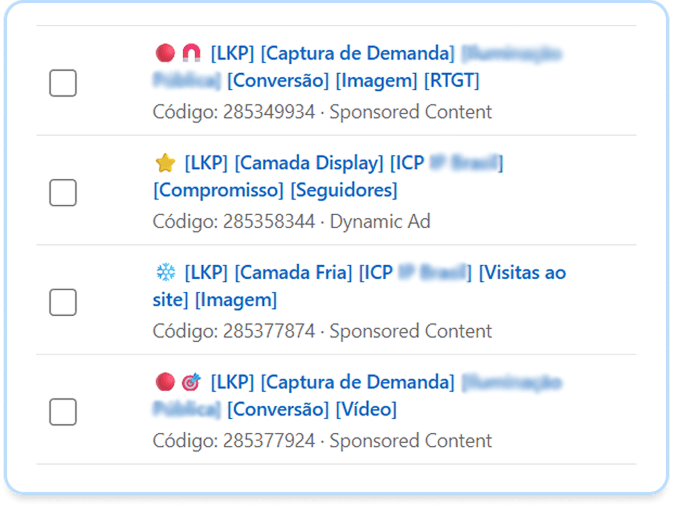
When you cross engagement data with your CRM, that naming reveals which topics each account engaged with, and your sales team can use it to personalize outreach.
ABM metrics and reporting on LinkedIn
In ABM, traditional paid media metrics can fool you. A high CTR doesn’t mean pipeline. A low cost per lead doesn’t mean a qualified account.
The indicators that really matter revolve around account behavior over time. A few examples:
- An account that got 60 impressions in week 1 and clicked 3 times in week 3 is moving to the next stage. That’s a stronger signal than any single campaign metric.
- An account that opened a deal in the CRM right after engaging with a specific use-case ad helps you validate which message is working for that profile.
- A campaign with a low CTR but a high volume of accounts moving stages is outperforming one with a high CTR and zero funnel movement.
These metrics require a data layer beyond what LinkedIn Campaign Manager gives you out of the box.
CRM integration and sales alignment
Your LinkedIn Ads campaign only becomes a predictable revenue engine when it’s connected to your CRM and aligned with sales. Without that integration, engagement signals stay stuck in the ad platform and lose their strategic value. (Here’s how to set up your LinkedIn Ads CRM integration.)
In practice, you can see the difference in how your SDRs reach out. Without integration, the outreach lands cold:
“Hi, we noticed your company could benefit from our solution.“
With integration and intent context, the outreach changes completely:
“I noticed your team has been checking out content on onboarding management. That’s exactly the problem we solve for companies like yours.“
That difference in context directly impacts reply rates and, as a result, the pipeline your campaign generates.
What to expect from real results
Companies that run ABM on LinkedIn consistently report impressive returns, but results don’t show up in the first few weeks.
ABM is a mid-term system: the first weeks build awareness, the following weeks surface intent, and pipeline starts forming from there.
The good news is that once the system is running, results become predictable and scalable. LinkedIn gives you the targeting you need. Consistent execution is what turns impressions into revenue.
Wrapping up
LinkedIn Ads for ABM isn’t a gamble; it’s a structured revenue strategy. Done right, it lets you pinpoint the right accounts, engage decision-makers with relevant messages and build pipeline predictably.
The elements that make a real difference range from building your list to integrating with your CRM, and each one has nuances that directly impact results.
If you want to go deeper on any part of this strategy, just give us a shout. 😉
Frequently asked questions
What is ABM on LinkedIn Ads?
It’s an account-based revenue strategy: you define target companies, engage their decision-makers with ads and accelerate opportunities, instead of chasing lead volume.
Which ABM model should I choose?
One-to-one for a few strategic, very high-ticket accounts; one-to-few for clusters of similar accounts (the sweet spot for most teams); one-to-many for awareness at scale.
Which metrics matter in ABM?
Account behavior over time: impressions and clicks per account, stage progression and opportunities opened in the CRM, far more than CTR or CPL.
Why connect LinkedIn Ads to your CRM for ABM?
Because account-level engagement signals give sales context, so reps can approach each account based on the topics it actually engaged with.