In a nutshell: B2B marketing doesn’t start with an ad, because marketing is much more than advertising: it’s analyzing the market as a whole to develop and position products, sell, and satisfy and keep customers. In B2B, and in digital marketing too, it starts with strategy: discovering (not just defining) your ICP from the deals you won and lost, choosing your positioning and message, and sizing the market with TAM, SAM and SOM. Channels come after that. The book Traction lists 19 traction channels, and the method is to test a few in parallel and put the budget behind what works. In paid media, LinkedIn Ads is the channel that reaches the buying committee by ICP, while Google Ads and Meta Ads add existing demand and retargeting. And all of it only proves itself when you measure pipeline and revenue in the CRM, not lead volume.
When someone asks me “how do I do B2B marketing?”, they almost always want to hear a channel.
“Run LinkedIn Ads.” “Do SEO.” “Hire an SDR.”
But the channel is the last decision, not the first.
A good channel with the wrong strategy just gets you to the wrong place faster. More leads from people who don’t buy. More meetings that don’t close.
So this post starts at the beginning: who buys from you, what you say to that company, how big that market is and only then, how to reach it.
Buckle up, this is a long one. But it’s worth it.
What is marketing?
Marketing is the holistic analysis of the market, meaning the market as a whole, with the goal of developing and positioning products, driving sales, and satisfying and keeping customers, creating value and profit.
That’s the definition I use. And notice what it doesn’t say: it never mentions ads.
Contrary to common sense, marketing isn’t just advertising.
Building the product, setting the price, choosing how it reaches the customer, communicating, adding value, solving the buyer’s need and taking care of the experience after the sale. All of that is marketing.
Advertising is just the most visible part.
And marketing isn’t new. Ever since markets have existed, whether through barter or money, someone has thought about how to stand out from other products.
Keep this definition in mind, because it changes how you read the rest of the post.
What is B2B marketing?
It’s the marketing of companies that sell to other companies. The goal isn’t “generating leads”. It’s generating business, predictably, with the companies most likely to buy and stay.
In practice, B2B marketing is a set of strategic decisions:
- What problem we solve
- Who it’s a priority for and where our solution makes sense (ICP)
- How big the opportunity is (market size)
- Why choose our solution and how to communicate it (positioning and message)
- How to reach those companies (channels and tactics)
- How to know it’s working (measurement tied to revenue)
The order matters. Each decision depends on the one before it.
And the sequence isn’t rigid: if the opportunity turns out too small or the results don’t show up, you go back to the earlier assumptions.
How is B2B marketing different from B2C?
In almost everything that affects how you plan.
| B2C | B2B | |
|---|---|---|
| Who decides | One person | A buying committee, with several people and interests |
| Sales cycle | Minutes to days | Weeks to months, sometimes more than a year |
| Market size | Millions of people | A finite list of companies |
| Deal size | Low to medium | Medium to very high, often recurring |
| Decision risk | Personal | Professional: whoever picks wrong answers for it |
| Role of sales | Small or none | Central, with consultative selling |
Two rows in that table change how you think about marketing as a whole.
Buying committee: you’re not convincing one person. You’re convincing the director who has the problem, the finance lead who approves, the technical lead who evaluates and the user who’ll use it. Each one needs a message.
Finite market: your list of possible customers runs out. You can’t “burn” leads the way B2C does. Every account handled badly is one less opportunity.
What is digital marketing?
It’s marketing done through digital channels: search, website, content, social media, email and paid media. The goal is the same as traditional marketing. What changes is the medium, and the medium changes how the message lands.
And the digital medium changed how people buy.
Before talking to any salesperson, a B2B buyer does research. They read, compare, ask colleagues, ask an AI to sum up the options. By the time they call sales, a good part of the decision is already made.
That’s why digital marketing cares about having a strong presence where that research happens. So that, when the question comes up, your company is the answer.
The channels are the same, but the way you use them changes a lot. B2B digital marketing works differently from B2C:
| Digital marketing in B2C | B2B digital marketing | |
|---|---|---|
| Who it talks to | One person, who decides alone | A committee, with several people at the same company |
| What it’s after | Volume and reach | The right accounts, from a finite list |
| Time to sale | Minutes to days, often on the website itself | Months, through sales |
| Where results are measured | In the online sale or the click | In the CRM: pipeline, deals and revenue |
The rest of this post is about the right-hand column.
What are the key digital marketing terms?
The usual concepts, seen through the eyes of someone who sells to companies:
| Term | What it is | The B2B angle |
|---|---|---|
| Inbound marketing | Attracting customers with relevant content instead of pushing offers | Works best combined with outbound and ads on ICP accounts |
| Content marketing | Turning the customer’s questions and pains into useful content | One piece of content for each committee role: who uses, who evaluates, who approves |
| Persona | A semi-fictional character that represents the buyer | Comes after the ICP: first the company, then the people inside it |
| SEO | Optimizing the website to show up in organic search | Niche terms with low volume and high intent are gold |
| GEO and AEO | Optimizing content to be cited in AI answers, like ChatGPT and Gemini (GEO, Generative Engine Optimization), and in search engines’ direct answers (AEO, Answer Engine Optimization) | Buyers ask AI to compare vendors: whoever has clear answers and expert content makes the shortlist |
| Lead | A person who left their details in exchange for an offer | A lead from a company outside the ICP isn’t a lead |
| Lead scoring | A score for the lead’s profile and behavior | Adds up the company profile, the job title and account engagement |
| Landing page | A page built for one action: sign-up or sale | The offer is an assessment, a demo or technical material, not a coupon |
| CTA | The call for someone to do something | “Talk to an expert” carries more weight than “buy now” |
| CRO | Optimizing the visitor-to-lead conversion rate | Short form, social proof and a clear offer for the right stage |
How does the digital marketing funnel work?
In five actions and three stages, with one difference: in B2B, the funnel logic moves by account, not just by person.
And not everyone who first comes across your brand will become a customer, since many people don’t have the profile, interest or timing to buy.
The five actions of the funnel:
- Attract the right people and companies.
- Convert interest into contact (a lead).
- Nurture and qualify until you identify the opportunities.
- Sell to the opportunities.
- Analyze the results and improve.
And the three stages the buyer goes through:
| Stage | What the buyer does | What B2B marketing delivers |
|---|---|---|
| Top (awareness) | Notices a problem and researches it to understand | Educational content, without pushing the product |
| Middle (consideration) | Already recognizes the problem and looks for ways out | Comparisons, case studies, technical content |
| Bottom (decision) | Builds a shortlist of vendors | Proof, a clear value proposition, a conversation with an expert |
In B2C, one person goes through the funnel. In B2B, several people at the same company are at different stages at the same time.
The technical lead is already at the bottom, comparing vendors. The CFO doesn’t even know the problem exists yet.
That’s why the right question isn’t “what stage is this lead at?” but “what stage is this account at?”.
A practical way to build that funnel in your ads, by time since the last interaction, is in the post on LinkedIn Ads attribution and audience windows.
Does the B2B journey follow a funnel?
No. And it’s worth debunking.
A funnel suggests a straight line: a person comes in at the top, moves down stage by stage and comes out a customer at the bottom. The real journey doesn’t work like that.
Google calls this the messy middle. Between the trigger and the purchase, the buyer loops back and forth between exploring options and evaluating them, many times and in no particular order.
In B2B it’s even messier, because several people at the same company are doing this at once.
And much of that journey happens where you can’t see it. For example, in dark social: the content and conversations that travel through private channels, with no trackable link and no attribution.
| What you can see | What happens behind the scenes |
|---|---|
| Ad impressions and views | A post shared in a group chat |
| Clicks | A chat by the coffee machine |
| Comments and reactions | A referral from a colleague or another customer |
| Website visits and form fills | A screenshot of your ad sent on Slack or Teams |
| Meetings booked | An event, podcast or community where someone mentioned your company |
So the funnel isn’t a map of the journey. It’s a way to organize the work and control what can be controlled.
The rest you don’t control. You influence it: by showing up consistently in the right accounts, so your company’s name comes up when the topic lands in a group chat or by the coffee machine. That’s what’s called demand generation.
That’s why, in B2B, measuring only the last click is misleading.
A simple tip: ask “how did you hear about us?” on the form or in the first meeting, as an open field.
It’s the cheapest way to see a slice of dark social.
How do you bring inbound and outbound into the same funnel?
With the Y funnel. It has two entrances and a single exit.

On the inbound arm, marketing attracts with content, SEO and ads, converts whoever arrives and nurtures those leads until they qualify.
On the outbound arm, the sales team uses the ICP to identify smart leads: the right people, at the right companies, before they raise their hand. Then it prospects, connects and qualifies.
Both arms flow into the same place. The qualified lead becomes an MQL, the opportunity sales accepts becomes an SQL and, in the end, a customer.
And the arrows between the arms matter. An inbound lead who didn’t reply can go into an outbound sequence. And a prospected account that isn’t ready yet can be nurtured by marketing. Nobody gets left behind by accident.
In outbound, what separates outreach from spam is personalization and cadence: several touchpoints, across different channels (email, phone, LinkedIn), with the right spacing between them. Mass email with no context isn’t a strategy.
Underneath it all sits the analysis. Without the numbers for each stage, you don’t know which arm is delivering.
How do you discover your ICP (and why defining isn’t discovering)?
By analyzing the deals you’ve already won and lost, not by writing down your dream company.
This is where the most expensive mistake in B2B marketing lives.
Most companies define their ICP: they sit in a room and write “tech companies, over 200 employees, that want to grow”. That’s a wish list.
Discovering it is something else. It’s looking at the data and asking: who actually buys from me, stays and gets results?
Sometimes the answer is scary. The company you thought was ideal has a 9-month cycle and a 5% close rate. And that segment nobody prioritized closes in 40 days.
One way to discover it:
- Export the won and lost deals from your CRM for the last 12 to 24 months.
- Enrich the companies with industry, size, region, revenue and, if it makes sense, the technology they use.
- Compare the groups. Close rate, average deal size, sales cycle and retention by industry, by size and by region.
- Look at your best customers, not the biggest logos. The ones who pay on time, stay, expand and refer.
- Look for the triggers. What was happening at the company when it bought? A new executive, a funding round, an expansion, a regulatory issue.
- Write verifiable criteria. “Manufacturers with 200 to 1,000 employees in the Midwest and the South” can be verified. “Innovative companies” can’t.
The result is an ICP you can defend with numbers. And one that changes when the data changes.
Are ICP, persona and buying committee the same thing?
No. The ICP describes the company. The persona describes one person inside it. The buying committee is the group of people involved in the decision.
First you choose the companies. Then, who inside them you need to convince.
How do you define your positioning and message?
By answering, in a way your ICP gets in seconds, why you and not the alternative.
Positioning isn’t a slogan. It’s choosing the place you want to hold in the customer’s mind.
A structure that works well:
- For whom: the ICP you discovered.
- What problem: the pain they feel, in their own words.
- What’s the alternative: what they do today. Sometimes it’s a competitor, often it’s a spreadsheet or “doing nothing”.
- What changes with you: the outcome, not the feature.
- Why believe it: proof. A case study, a number, a well-known customer.
Putting it together: “For [ICP] struggling with [problem] who today solve it with [alternative], we deliver [outcome], and [proof] shows it.”
Then comes the message for each committee role.
The director wants to know about the outcome. Finance wants to know about return and risk. The technical lead wants to know if it integrates and how much work it takes. Same positioning, different arguments.
How big is your market? TAM, SAM and SOM
They’re three layers of the same market, from largest to smallest.
- TAM (Total Addressable Market): the total market. Every company that could use your solution.
- SAM (Serviceable Available Market): the part of the TAM you can serve today, with the product, region and sales model you have.
- SOM (Serviceable Obtainable Market): the slice of the SAM you can realistically win in a given period, with the team and budget you have.

A hypothetical example, for software aimed at manufacturers:
| Layer | Criteria | Companies | Potential revenue per year ($12,000 per customer) |
|---|---|---|---|
| TAM | Manufacturers with more than 100 employees in the US | 15,000 | $180 million |
| SAM | Only the industries and regions you serve today | 4,500 | $54 million |
| SOM | What you can win in 3 years | 225 | $2.7 million |
The numbers in the example are made up. The method isn’t.
In B2B, I like to count the market in companies, not just in dollars. Because the list of companies is what turns into an action plan.
The SAM becomes your account list. The SOM becomes your target. And the size of that list defines, for example, the right audience size on LinkedIn Ads: ICP accounts times the committee members at each account. The post on LinkedIn Ads targeting shows that math.
And there’s a nice side effect: once you know the SAM has 4,500 companies, it’s clear you can’t treat them all the same. A few hundred deserve individual attention. That’s where ABM comes from.
What B2B marketing strategies are there?
Several, but they’re not on the same level. Before the list, it’s worth separating four layers that often get mixed up:
- Strategy: the choices from the start of this post. Where to compete, which customers to prioritize and what value to deliver.
- Growth approach: how you generate demand and reach those customers. ABM, inbound, outbound, product-led.
- Channels: where it happens. LinkedIn, Google, email, events, partners.
- Tactics: the concrete actions. A retargeting campaign, a webinar, a prospecting sequence.
The line between one layer and the next isn’t rigid. But it helps you avoid a common mistake: calling a channel a strategy.
LinkedIn Ads isn’t a strategy. It’s a channel that can execute ABM, inbound or outbound.
The most common approaches in B2B, by what each one decides:
| Approach | What it decides | In practice |
|---|---|---|
| ABM | Where to focus the effort | Choosing the highest-value accounts and working each one with marketing and sales together. See how to do ABM with LinkedIn Ads. |
| Inbound | How to attract | Content, SEO and resources so people already researching the problem find you |
| Outbound | How to reach people who haven’t raised their hand yet | Prospecting with SDRs, email and LinkedIn, plus paid media to cold audiences. It works better when the account has already seen you: that’s warm outbound. |
| Founder-led growth | Who the market trusts | The founder and executives as a source of authority and distribution. The founder-led growth playbook walks you through it. |
| Partnerships and ecosystem | Where to sell beyond your own team | Resellers, integrations and companies that already serve your ICP |
| Product-led growth | Who does the selling | The product itself: a free trial or free plan drives acquisition, activation and expansion |
They’re not mutually exclusive. One almost always wraps around the others.
An example: the strategy is ABM on 300 accounts. Inside it, inbound educates the buyers at those accounts with executive content. Outbound reaches those same people with LinkedIn Ads and an SDR sequence. And founder-led growth lends authority to both ends.
To choose which approach leads, deal size and market size help. A high deal size and a small market pull toward ABM and outbound. A low deal size and a large market pull toward inbound and product-led.
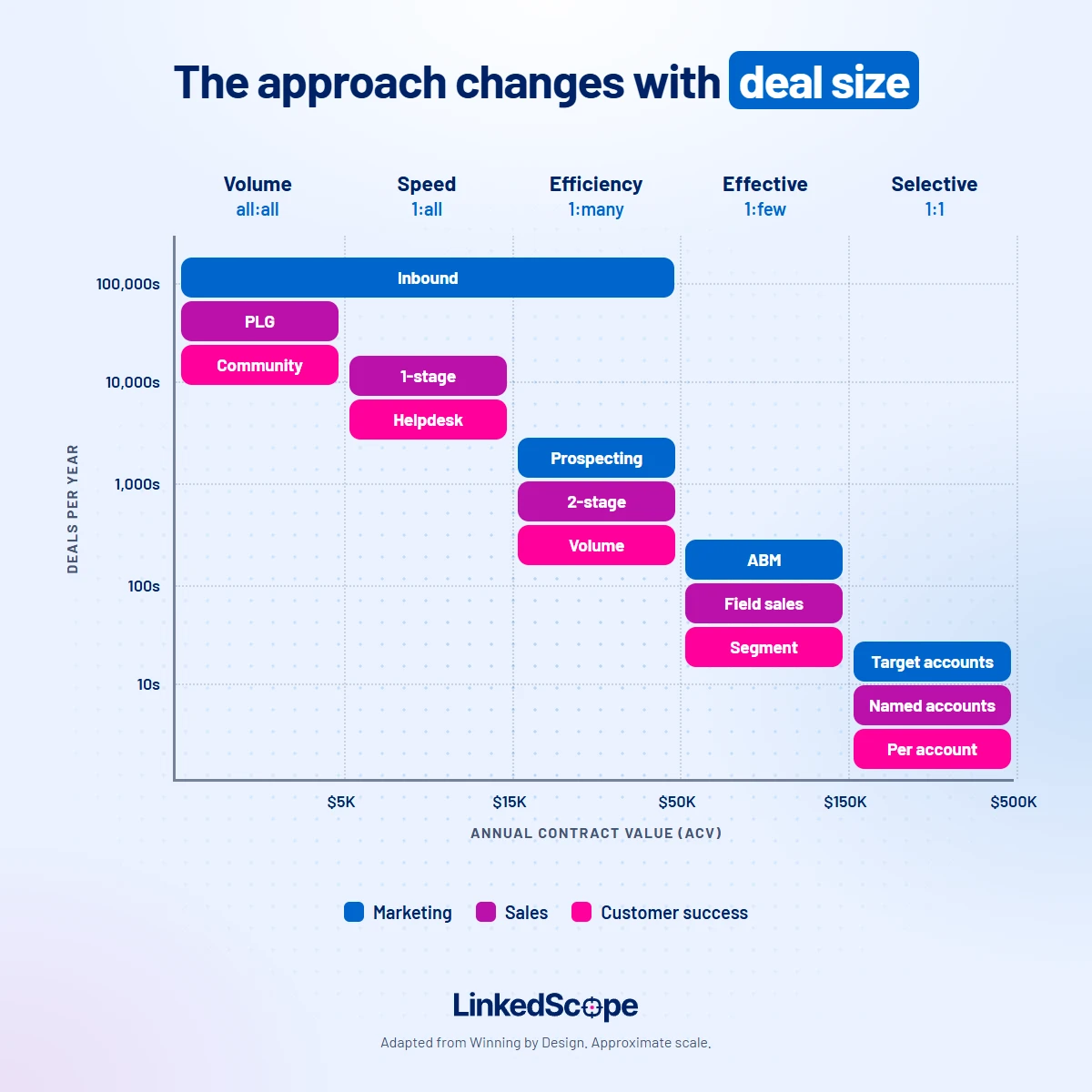
The higher the annual contract value, the fewer deals per year and the more personalized the approach. At low deal sizes, volume comes from product-led, inbound and community. At high deal sizes, ABM, field sales and per-account customer success come in.
How do you plan your B2B marketing strategy before choosing channels?
By answering four blocks of questions. It’s tempting to jump straight into action, but the plan is what makes your actions complement each other instead of competing.
- Goal: what do you want right now? To get known in the market, generate pipeline, break into specific accounts, expand your current base?
- Action plan: who you talk to, which pains you solve, what content you create, which channels you use to distribute it and who creates it.
- Competition: where competitors show up, what words they use, what they publish and how the market reacts. To see the ads they’re running, use the LinkedIn Ad Library.
- Measurement: which metrics matter to the business, where they’ll be measured and how often.
The fourth block is the one most people skip. And it’s the most important: no action should start without knowing how it’ll be measured.
What are the 19 traction channels for B2B marketing?
They’re the 19 acquisition channels from the book Traction, by Gabriel Weinberg and Justin Mares. The book’s thesis is simple: most companies use the same two or three channels out of habit and never test the others.
Here are the 19, with my take on how much each one usually weighs in B2B:
| Channel | How it shows up in B2B | Weight in B2B |
|---|---|---|
| Sales | Sales team, SDRs, outbound | Almost always essential |
| Business development | Strategic partnerships, resellers, integrations | Strong |
| Content marketing | Blog, guides, newsletter, video | Strong |
| SEO, GEO and AEO | Showing up when the customer searches for the problem | Strong |
| SEM (search ads) | Google Ads for demand that already exists | Strong |
| Social and display ads | LinkedIn Ads, Meta Ads, display | Strong |
| Offline events | Meetups, workshops, customer dinners | Strong |
| Trade shows | Booth, trade show presence | Depends on the industry |
| Speaking engagements | A stage at events in your market | Strong for authority |
| Community building | Group, community, customer club | Strong in the long run |
| Email marketing | Nurturing, newsletter, relationships | Strong |
| Publicity | Coverage in industry publications | Medium |
| Unconventional PR | Stunts that spark spontaneous conversation | Medium |
| Targeting blogs and niche influencers | Showing up where your ICP already reads | Medium |
| Affiliate and referral programs | Commission for whoever refers | Medium |
| Existing platforms | App marketplaces, software directories | Depends on the product |
| Engineering as marketing | Free tool, calculator, assessment | Strong for SaaS |
| Viral marketing | A product that spreads through use | Rare in B2B |
| Offline ads | Radio, TV, billboards, magazines | Rare in B2B |
The book’s method for choosing (the “Bullseye”) is the one I use most:
- Brainstorm ideas for all 19 channels, even the ones that seem unrelated.
- Pick the most promising ones for your ICP.
- Test three in parallel, with a small budget and timeline and one clear metric.
- Focus on what worked. And go back to the list when it saturates.
Heads up: the channel that works for your competitor may not work for you. And the channel nobody in your industry uses might be the cheapest.
And don’t fall for the temptation to be everywhere. It’s better to master one channel and build a relevant presence there than to be on ten without doing any of them well.
Master one. Then move on to the next.
Where does paid media fit in B2B marketing?
As the channel that buys precise reach, at the moment you choose. Content and SEO take time to kick in. Sales doesn’t scale on its own. Paid media speeds up both.
But each network plays a different role:
| Channel | Role in B2B | Main strength |
|---|---|---|
| LinkedIn Ads | Reaching the buying committee at ICP accounts | Targeting by company, industry, company size, job title and seniority |
| Google Ads | Capturing people already looking for the solution | Declared intent in search |
| Meta Ads | Cheap frequency and retargeting | Reach and a low cost per impression |
How to combine the three, including how much to invest in each, is in the post on B2B paid media. And the head-to-head comparisons are in LinkedIn Ads vs. Google Ads and LinkedIn Ads vs. Meta Ads.
Why is LinkedIn Ads the most B2B channel in paid media?
Because it’s the only one that targets by what B2B needs most: the company and the job title.
Remember the ICP you discovered and the SAM with 4,500 companies? On LinkedIn you upload that list as a company audience and show the ad to the director, the finance lead and the technical lead at each of them.
That’s ABM with ads. No other network does it the same way.
The price is that clicks cost more. That’s why LinkedIn pays off when targeting is precise and measurement is tied to the CRM, not to cost per lead. The post on LinkedIn Ads cost explains where that cost comes from, and the LinkedIn Ads guide shows how to plan your first structure.
And LinkedIn isn’t just ads. Your profile, organic content and Thought Leader Ads work together, as I show in the post on LinkedIn marketing for B2B.
How do Google Ads and Meta Ads add to retargeting?
LinkedIn Ads opens the door at the right accounts. Google Ads and Meta Ads keep your brand in front of those people, at a lower cost, while the cycle moves along.
Someone who visited your site after a LinkedIn ad can see you again on Google and Instagram. And your CRM lists (open deals, customers, lost deals) become audiences on all three networks.
The step-by-step is in the B2B retargeting playbook and in the post on CRM audiences.
How do you convert interest and hand the lead to sales?
By optimizing conversion, qualifying before the handoff and connecting marketing and sales in the CRM.
Converting matters as much as attracting. Doubling a page’s conversion rate is usually cheaper than doubling its traffic. That’s the job of CRO: a clear offer, a short form, social proof and the right call to action for the visitor’s stage.
Is every lead a qualified lead?
No. And mixing the two up is what damages the relationship between marketing and sales the most.
A qualified lead goes through three filters:
- Profile: the company is in the ICP and the person has a role in the decision.
- Behavior: the account is engaging, visiting, consuming content. Lead scoring helps automate these first two filters.
- Readiness: the company recognizes the problem and wants to solve it now. This one almost always takes a conversation.
In B2B, this usually turns into two acronyms: MQL, the lead marketing approved, and SQL, the one sales agreed to work.
You wouldn’t ask someone to close a deal at the first “hi”, right? Handing an unqualified lead to sales is exactly that.
How do you align marketing and sales?
With agreed rules and the CRM in the middle.
- A shared definition of a qualified lead, written down and accepted by both teams.
- Goals tied to the same number: pipeline and revenue for both teams, not leads on one side and sales on the other.
- Automatic handoff: the qualified lead lands in the CRM, at the right stage and with the right owner, no spreadsheets.
- Feedback to marketing: what sales learns (good lead, bad lead, deal won) flows back to marketing and to the ad platforms as a signal. The LinkedIn Conversions API is one way to do this.
How do you measure B2B marketing?
By what happens in the CRM, not by lead volume.
A lead is the start of the story. If you only measure leads, the team will optimize for leads. And cheap leads are almost always leads that don’t buy.
A simple way to organize your goals: reach, influence, conversion, reputation and revenue. If your strategy grows these five over time, you’re on the right track.
The metrics that count:
- Sourced and influenced pipeline: how much opportunity marketing helped create.
- Close rate and cycle: whether deals that go through marketing close more and faster.
- Revenue and acquisition cost: how much each new customer cost.
- Market penetration: how many companies in the SAM have been reached and engaged.
And accept one limit: in B2B, no tool attributes 100% of a sale to a single channel. The decision goes through many people and many channels. The post on LinkedIn Ads reporting shows how to separate what leadership wants to see from what the team needs to track.
Why measure beyond acquisition?
Because the funnel doesn’t end at the sale.
Traditional marketing usually optimizes only the first two stages: awareness and acquisition. Growth marketing looks at the whole funnel, the well-known AAARRR pirate funnel.
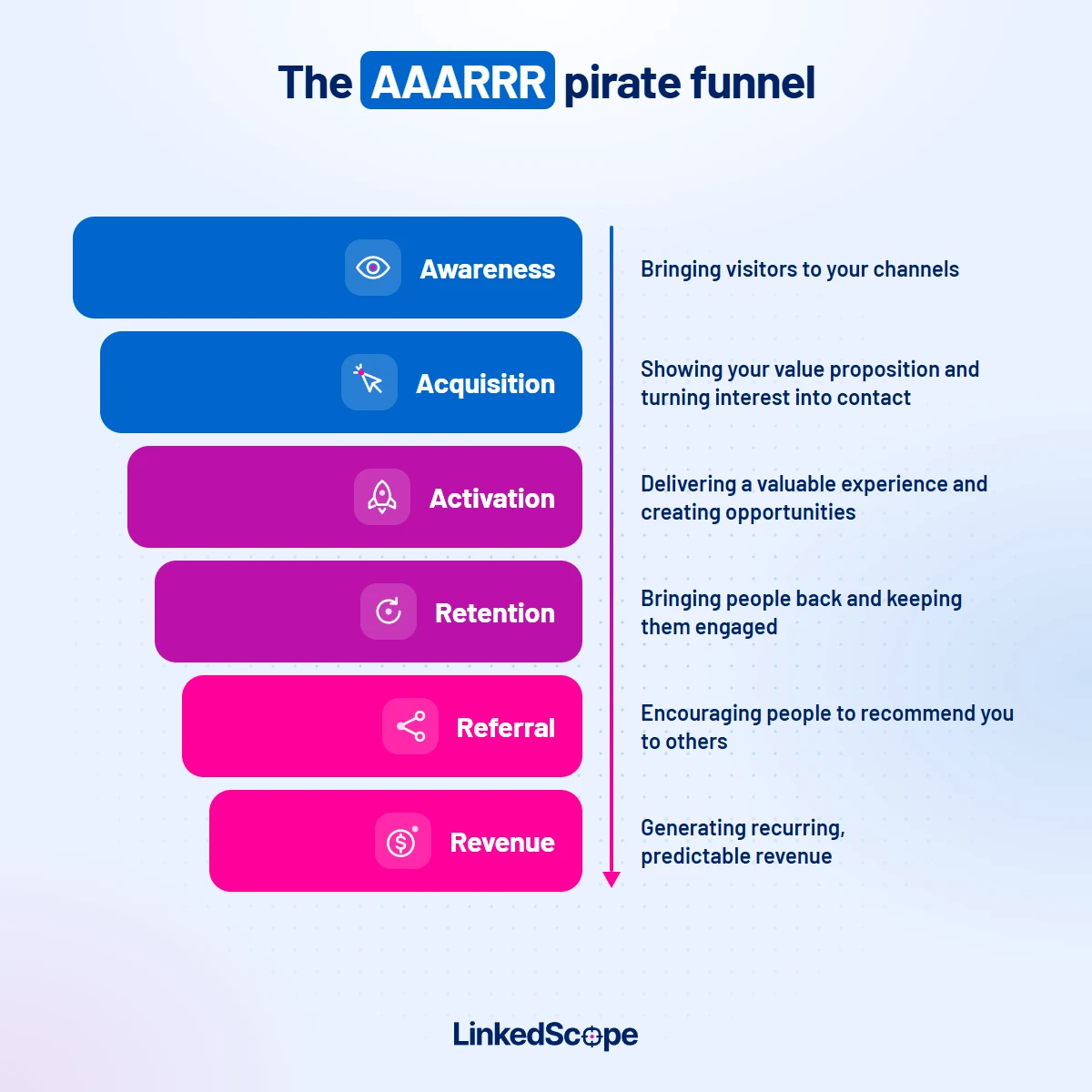
Remember the definition at the start of the post? Marketing is also about satisfying and keeping customers. In B2B, where the market is finite, the company that stays, expands and refers is worth more than a lot of new leads.
For each stage, a few questions that need answers:
| Stage | What you need to know |
|---|---|
| Awareness and acquisition | How many visits and leads each channel brings, and how much each lead, opportunity and customer costs per channel |
| Activation | How many opportunities (meetings, demos, trials) you generate and the conversion rate at each stage |
| Retention | How many customers cancel (churn) and how many contacts come back to your channels |
| Referral | How many referrals customers make, how many turn into deals and what your NPS is |
| Revenue | Average deal size, sales cycle, LTV, return per channel and the reasons you lose deals |
If any of these goes unanswered, fix your measurement before raising the budget.
Intelligence without action is waste. And action without intelligence is recklessness.
What B2B marketing tools should you use?
One per function, talking to each other. The right tool matters less than the data flowing from one to the next.
- CRM: the source of truth for deals and accounts. HubSpot, Salesforce, Pipedrive, Microsoft Dynamics 365, RD Station CRM, Clientify.
- Marketing automation: email, nurturing and forms.
- Paid media: LinkedIn Ads, Google Ads and Meta Ads.
- Prospecting: enrichment and sequences, with tools like Apollo, Snov.io and WaLead.
- Account-based measurement: matching your ads with your CRM to see which companies were reached and how much of the pipeline went through the ads. That’s what LinkedScope does.
- Artificial intelligence: ChatGPT, Claude and Gemini to research accounts, craft the message for each committee role, analyze data and speed up content production.
With the LinkedScope MCP, Claude or ChatGPT can access your ad and CRM data. So you can ask “which ICP companies did our ads reach this month, and which ones already have an open deal?” and get the answer with real numbers. And, with your approval, the AI itself adjusts your campaigns.
Frequently asked questions
How long does B2B marketing take to show results?
It depends on the channel and the sales cycle. Paid media and outbound usually start conversations within weeks; content and SEO take months to kick in.
Since the B2B cycle is long, revenue shows up later. Early on, track pipeline and engagement from ICP accounts.
What’s the difference between an MQL and an SQL?
MQL (Marketing Qualified Lead) is the lead marketing approved: the company is in the ICP, the person has a role in the decision and the account is engaging.
SQL (Sales Qualified Lead) is the lead sales agreed to work, after confirming interest and timing. Both teams need to agree on the handoff rule between the two.
Inbound or outbound: which works better in B2B?
Almost always both together. Inbound attracts people who are already researching; outbound goes after ICP accounts that haven’t raised their hand yet.
A high deal size and a small market lean more toward outbound and ABM. A low deal size and a large market lean toward inbound.
Can you do B2B marketing on a small budget?
Yes, as long as you focus: a tightly defined ICP, one or two channels and a clear offer.
On LinkedIn Ads, a lean structure does the job. The post on LinkedIn Ads on a small budget shows how to set it up.
Does B2B marketing need SDRs?
Not always. SDRs make sense when the deal size pays for the team and the market calls for active outreach, as in outbound and ABM.
With a low deal size and high volume, inbound, automation and product-led usually cover it, with sales stepping in only on the opportunities.
How much should you invest in B2B marketing?
There’s no magic number. Start from the goal: how many customers you need, how many opportunities that takes at your close rate and how much it costs to generate each one.
For LinkedIn ads, the post on LinkedIn Ads budget runs that math.