In a nutshell: LinkedIn Ads objectives fall into three groups: Awareness (brand awareness), Consideration (website visits, engagement and video views) and Conversions (lead generation and website conversions). Your objective decides how the algorithm optimizes bids and which formats are available. To choose, ask what the next action you want your audience to take is, and evaluate each campaign with the metrics for its funnel stage.
You opened LinkedIn Campaign Manager, got to the campaign creation step and hit that simple question a lot of people get wrong: what’s your objective?
Sounds trivial. It isn’t.
Choosing your LinkedIn Ads objective isn’t about gut feeling or preference. It decides how the algorithm optimizes your bids, which ad formats are available and, at the end of the day, whether the money you spent comes back as real results or as vanity metrics that don’t pay the bills.
So before you start clicking whatever looks right, it’s worth understanding what each option really means.
Keep reading to find out!
What are LinkedIn Ads objectives?
LinkedIn Ads objectives are part of the platform’s objective-based advertising setup, which in practice means you don’t create a generic ad and hope for the best. You declare an intent, and LinkedIn uses it to optimize campaign delivery around it.
You know how you tell someone where you’re headed before asking for a ride? It’s kind of like that.
In Campaign Manager, the objective is the first step after naming your campaign and assigning it to a group. That choice steers everything that follows: available formats, bidding options and the kind of audience you’ll reach most efficiently.
Objectives are grouped into three categories that match the classic marketing funnel stages:
- Awareness (for people who don’t know you exist yet)
- Consideration (for people who know you but are still evaluating)
- Conversions (for people ready to act)
Simple as that. The trouble starts when people pick the objective that sounds best instead of the one that actually reflects the campaign’s goal.
What campaign objectives are available?
Brand awareness
This objective has one very specific job: maximizing the number of people who see your ad. It optimizes for impressions, not clicks or actions.
If you’re launching a company, introducing a new solution to the market or simply want more people to know you exist, this is Brand Awareness’s moment.
What it isn’t: an excuse to advertise without a clear message. Lots of companies use this objective as an escape hatch when they don’t know what they want. “Let’s do some branding” has become code for a campaign with no real goal. Don’t fall for it.
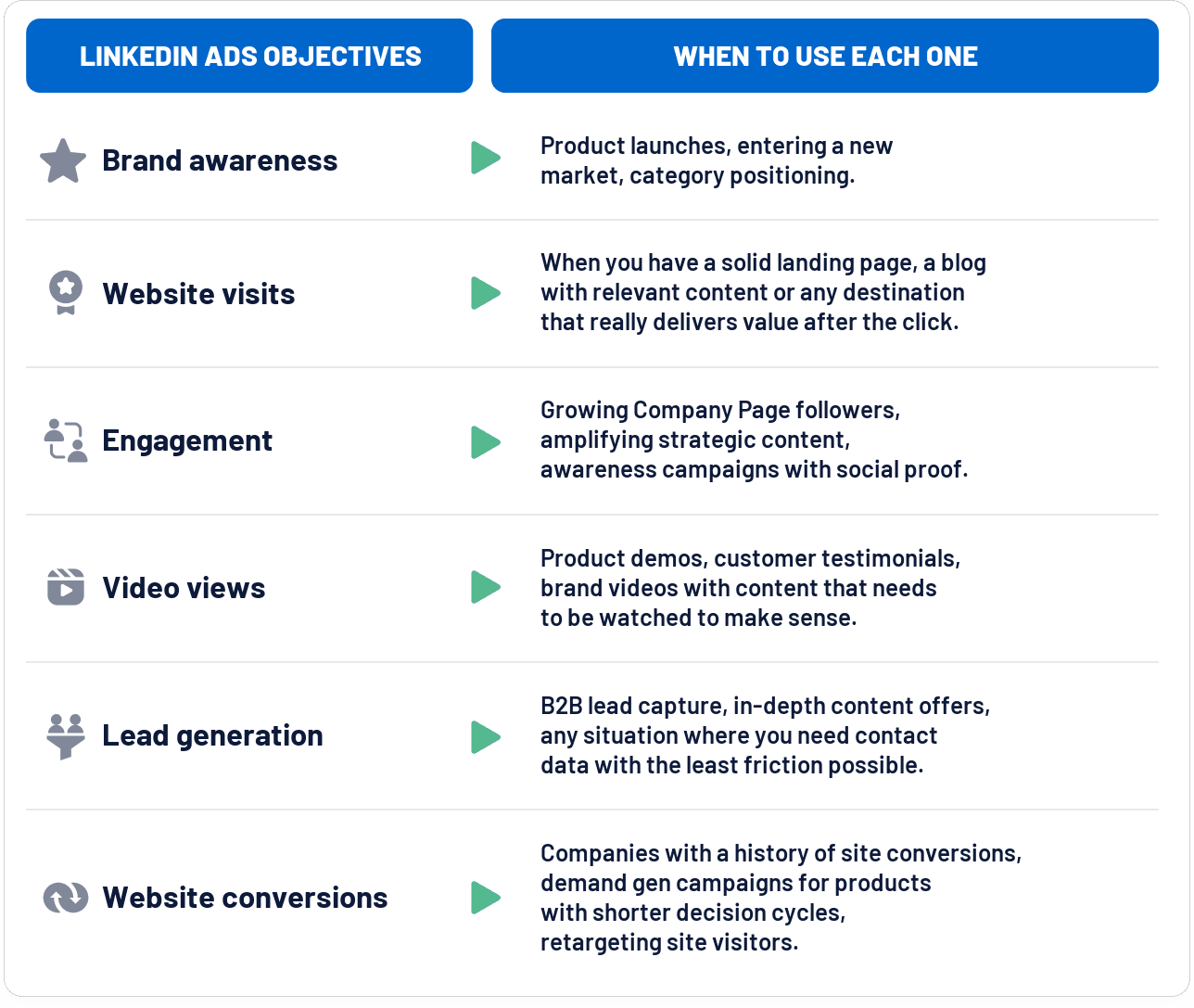
When it makes sense: product launches, entering a new market, category positioning.
Website visits
Here the focus shifts: you want clicks that send people to your site. The algorithm optimizes delivery for people more likely to click your ad.
It’s the most used objective and also one of the most misused. There’s no point driving visits to a page that isn’t ready to convert. If your site is slow, not optimized or doesn’t give people the info they’re looking for, you’re paying to bring in people who’ll leave without doing anything.
When it makes sense: when you have a solid landing page, a blog with relevant content or any destination that actually delivers value after the click.
Engagement
Want people to like, comment, share or follow your Page? That’s what the Engagement objective is for.
It makes a lot of sense for audience-building strategies on LinkedIn, especially if you’re investing in organic content and want to amplify specific posts.
But here’s the catch: engagement isn’t conversion. If you need leads now, not likes, this objective will frustrate everyone in the results meeting.
When it makes sense: growing your Page followers, amplifying strategic content, awareness campaigns with social proof.
Video views
This objective exists for a practical reason: it’s the only one that lets you bid on cost per view (CPV). Video as a format is available under other objectives, but per-view bidding is exclusive to this one.
If you have a well-made video with a clear message (and you know video is the best medium for that content), this objective makes sure you pay for people who actually watched, not just those who saw the thumbnail.
When it makes sense: product demos, customer testimonials, brand videos with content that needs to be watched to make sense.
Lead generation
This is one of LinkedIn’s most powerful objectives. Lead generation uses the platform’s native forms, auto-filled with the member’s profile data.
That slashes friction. People don’t need to leave LinkedIn, type their work email or fill out 12 fields. The data is already there. One click and the lead is in.
Conversion rates tend to be significantly higher than campaigns that send people to an external landing page, especially on mobile, where filling out forms is torture.
Watch out, though: lead quality depends on your targeting and your offer. A form that’s easy to fill out is also easy to fill out by accident or out of passing curiosity. Your lead magnet needs to be good and relevant to the right audience.
When it makes sense: B2B lead capture, in-depth content offers (e-books, webinars, demos), any situation where you need contact data with as little friction as possible.
Website conversions
This objective optimizes for specific actions on your website, like downloads, external form fills, purchases or sign-ups. But there’s one non-negotiable condition: you need conversion tracking set up correctly with the LinkedIn Insight Tag.
Without it, the algorithm is flying blind. With it, it learns from your converters’ behavior and starts finding people like them.
It’s a bottom-of-funnel objective for teams that already have data volume, a more mature paid media operation and know exactly which site action represents real business value.
When it makes sense: companies with a history of site conversions, demand generation campaigns for products with shorter decision cycles, retargeting site visitors.
How to pick the right objective for your LinkedIn Ads campaign
The right question isn’t “which objective looks best?” but “what’s the next action I want my audience to take?”
- If they’ve never heard of you: Brand awareness.
- If they need to click and understand what you do: Website visits.
- If you want to build an audience on LinkedIn: Engagement.
- If video is your main format and views are the metric that matters: Video views.
- If you need leads with minimal friction: Lead generation.
- If you have tracking in place and want to optimize for site actions: Website conversions.
The most common mistakes when choosing LinkedIn Ads objectives (and how to avoid them)
At some point, everyone has gotten objectives wrong in LinkedIn campaigns. Write down the most common mistakes and how to avoid each one:
Mistake 1: using Website visits when the landing page doesn’t convert
This one’s the frequency champion. The company wants leads, picks Website visits, drives traffic, and at the end of the month the report shows hundreds of clicks and zero opportunities in the CRM.
The problem is rarely the objective itself. A slow, generic landing page with no clear CTA or value prop will waste any amount of traffic you send its way.
There are two fixes: either you fix the landing page, or you switch to the Lead generation objective and use LinkedIn’s native form.
Mistake 2: choosing Brand awareness to dodge pressure for results
“Let’s run a branding campaign” is a phrase that, at a lot of companies, works as a classy escape from targets nobody knows how to hit. Brand awareness shows up not because the strategy calls for it, but because impression metrics are easier to defend in a presentation.
The problem is that it wastes budget on a funnel stage where your audience isn’t, and it opens a huge gap between what the campaign delivers and what the business needs.
Brand awareness has its place. But that place is when you genuinely need to expand your reach to an audience that doesn’t know you yet, not when sales needs leads and your bottom-of-funnel campaign isn’t performing.
Mistake 3: judging top-of-funnel objectives with bottom-of-funnel metrics
This mistake doesn’t happen when you create the campaign; it happens when you analyze the results.
You set up an Engagement campaign to grow your Page audience, and in the results meeting someone asks: “but how many leads did it bring in?” The answer is zero. Because that was never the goal.
Each funnel stage has its own metrics. Brand awareness is judged by impressions, reach and frequency. Engagement by likes, comments, shares and new followers. Lead generation by lead volume and quality. Website conversions by specific actions with tracked value.
Mixing these up doesn’t just lead to wrong conclusions about the campaign; it leads to wrong decisions about what to do next.
Mistake 4: using Website conversions without the Insight Tag
This is the most technical mistake on the list. The Website conversions objective fundamentally depends on conversion tracking to work properly. Without the Insight Tag installed correctly on your site (and conversions mapped in Campaign Manager), the algorithm has no data to optimize for.
Before launching any campaign with this objective, confirm the tag is installed, firing correctly and that at least one conversion is set up and being recorded.
Mistake 5: choosing the objective based on ad format, not the goal
This is the mistake of someone with some experience who’s still thinking backwards. The logic goes: “I want to use Message Ads, so let’s see which objective allows that format.” Result: the chosen objective doesn’t reflect the campaign’s real goal, and optimization heads in the wrong direction.
The right path is the opposite: first define what you want your audience to do. Then pick the objective that matches that action. Then look at which formats are available within that objective and choose the best fit for your message.
Format serves strategy, not the other way around.
Wrapping up
In LinkedIn Ads, choosing your objective is where strategy meets execution. Skipping this step (or treating it as a form-filling detail) is the fastest way to spend well and perform badly.
The good news: the available objectives cover the whole funnel, are straight to the point and, used with the right targeting, deliver concrete results.
The question you need to answer before creating any campaign is simple: what do I want this person to do after seeing my ad?
The answer to that question is your objective.
Frequently asked questions
What are the LinkedIn Ads objectives?
Brand awareness, website visits, engagement, video views, lead generation and website conversions, grouped into Awareness, Consideration and Conversions.
Which objective should I use for B2B lead gen?
Lead generation, with native forms that auto-fill from profile data and cut friction, especially on mobile.
Can I use Website Conversions without the Insight Tag?
No. Without the Insight Tag installed and conversions set up, the algorithm has no data to optimize for.
Which objective lets you bid by view (CPV)?
Only the Video Views objective lets you bid on cost per view.