In a nutshell: B2B paid media isn’t about picking the cheapest platform. B2B has a buying committee, a long sales cycle and a finite list of companies that can buy from you. That’s why each channel plays a role: Google Ads captures people already searching, Meta Ads gives you cheap reach and frequency, and LinkedIn Ads makes sure you’re talking to the right company and the right job title. You split the budget by where your market is, not by a magic percentage. And the metrics that matter are ICP accounts reached, qualified leads and pipeline in the CRM, not CPL.
Paid media playbooks are everywhere.
Courses, templates, “the algorithm will find your buyers”…
And that’s fine. The problem is that most of it was built for e-commerce, info products and local businesses.
Then a B2B company copies that recipe, runs an Instagram campaign, celebrates the cheap leads…
And sales ends up calling an intern, a student and a competitor checking prices.
Yep.
In this post I’ll show what changes in B2B paid media: the role of each channel, how to split the budget between LinkedIn Ads, Google Ads and Meta Ads, and which metrics to watch so you don’t fool yourself.
What is B2B paid media?
B2B paid media is paid advertising that gets the right message to the companies and people who make buying decisions in your market. The goal isn’t traffic volume or cheap leads. It’s opening and speeding up opportunities in the accounts that can become customers.
The mechanics are the same as in B2C: you pay to show up on Google, Instagram or LinkedIn.
What changes is who buys and how they buy.
What changes from B2C to B2B paid media?
Almost everything that matters when you pick channels and metrics. Check it out:
| B2C | B2B | |
|---|---|---|
| Who decides | One person | A buying committee (who uses, who pays, who approves) |
| Time to decide | Minutes or days | Months |
| Market size | Millions of people | A finite list of companies that fit your ICP |
| Deal size | Low, repeat purchases | High, long contracts |
| What success looks like | Sales, ROAS | Engaged ICP accounts, opportunities and deals in the CRM |
The practical consequence: in B2B, who clicks matters a lot more than how many click.
A thousand visits from people outside your ICP are worth less than twenty visits from directors at the right companies.
And since the decision takes months, most of your market isn’t buying right now. They need to remember you when the time comes. That’s the logic of demand generation on LinkedIn.
What role does each channel play in B2B paid media?
Each channel is great at one thing and weak at another. The game is putting each one in the right role:
| Channel | What it does well | Where it falls short in B2B | Role |
|---|---|---|---|
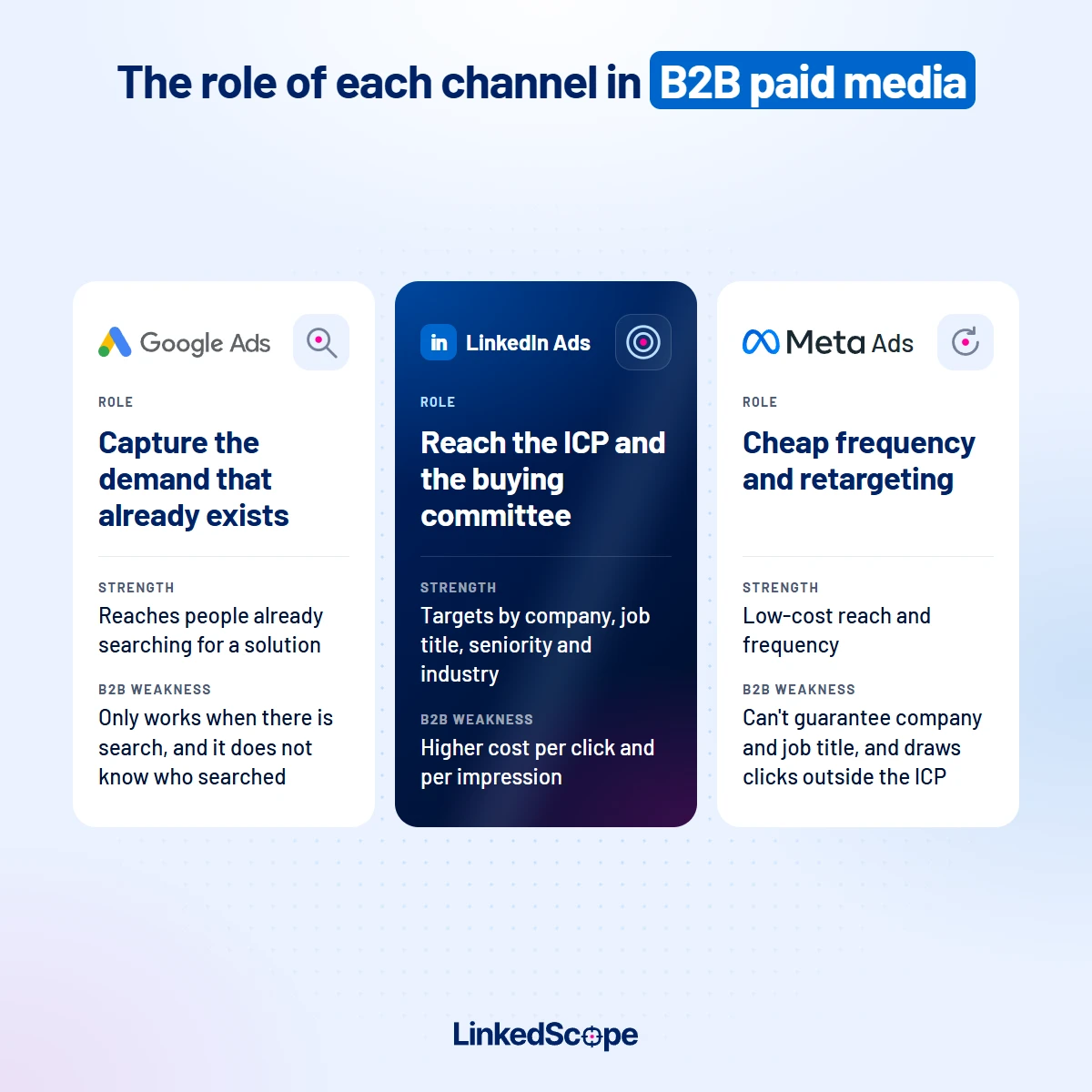
| Google Ads | Reaches people already searching for the solution | Only works when there’s search; doesn’t know the company or job title of who searched | Capture the demand that already exists |
| Meta Ads | Cheap reach and frequency | Can’t reliably target by company and job title; draws lots of clicks outside the ICP | Cheap frequency and retargeting |
| LinkedIn Ads | Targets by company, job title, seniority and industry | Higher cost per click and per impression | Make sure the message reaches the ICP and the buying committee |
Google Ads: the demand that already exists
When someone searches for “fleet management software”, they already know what they want. Google is unbeatable at catching that intent.
The catch is that it only works if there’s search. New products, new categories and small niches usually have little volume.
And search doesn’t tell you who the person is. Students, competitors and vendors search the same words.
Meta Ads: reach and frequency
Meta delivers cheap impressions and a lot of reach. In B2B, that’s great for one thing: showing up again for people who already know you, at a low cost.
As cold prospecting, it struggles. Targeting is based on interests and behavior, and you can’t guarantee the click came from someone in your ICP.
LinkedIn Ads: the professional identity filter
On LinkedIn, you pick the industry, company size, job function, seniority and even the exact list of companies you want to reach.
That’s why it costs more. And that’s why, in B2B, it’s usually the foundation: it’s the only one of the three that guarantees the impression landed at the right company.
The details on targeting well are in the post on LinkedIn Ads targeting. And if the question is price, the post on how much LinkedIn Ads costs explains where the cost comes from.
If you want a head-to-head between two channels, we’ve got that too: LinkedIn Ads vs Google Ads and LinkedIn Ads vs Meta Ads.
How do you split the budget between LinkedIn Ads, Google Ads and Meta Ads?
There’s no right percentage. Your paid media strategy depends on where your market is. I’d start by answering three questions:
- Are people searching for what you sell? Open Keyword Planner and check the volume. If there’s search with clear intent, Google comes in early, because it’s the hottest demand there is.
- Is your market a finite list of companies and job titles? If you can list the accounts that could buy from you, LinkedIn becomes the foundation. It’s what keeps you present in those accounts, including the ones that aren’t searching yet.
- Do you already have traffic and lists to retarget? If so, Meta comes in as cheap frequency for people who visited or are already in the CRM. If not, it’s not its turn yet (though a few cold demand capture tests can be worth it too, depending on the context). How to turn your CRM into audiences on each channel is in the post on lookalike audiences.
In practice, three common scenarios:
| Scenario | Where to start | What comes next |
|---|---|---|
| Known category, lots of search | Google Ads on bottom-of-funnel searches | LinkedIn to filter and warm up the committee at the accounts that visited |
| New category or little search | LinkedIn Ads on the ICP | Meta and Google as retargeting for the people LinkedIn sent to the site |
| Tight budget | One channel, done well | Open the second channel once the first has enough traffic to feed retargeting |
With little money, spreading the budget over three channels is the fastest way to get results in none of them. The post on LinkedIn Ads on a small budget shows how to focus. And the one on LinkedIn Ads budget helps you do the math.
How do the channels work together?
Through retargeting. One channel brings people to the site and the other reaches them again, each doing what it does best.
The two most useful moves:
- Google or Meta bring volume, LinkedIn filters. You retarget visitors on LinkedIn, but only the ones in your ICP. You pay the expensive click only for people who already showed interest and have the right profile.
- LinkedIn brings quality, Google and Meta add frequency. A visitor who came from LinkedIn already passed the filter. Reaching them again on Google and Meta is cheap.
I walked through the four flows, step by step, in the B2B retargeting playbook with LinkedIn Ads, Google Ads and Meta Ads.
Which metrics should you use in B2B paid media?
Business metrics, by account, tied to the CRM. CPL and CTR per platform are campaign health signals, not results.
What I’d track:
- ICP accounts reached and penetration: how many companies on your list saw your ads. You can see this on LinkedIn, and I show how in the post on companies reached by LinkedIn Ads.
- Engagement by account: which companies are clicking, watching videos, opening forms.
- Qualified leads, not raw leads: the ones sales accepted. You can send that signal back to the platforms and optimize for it (see LinkedIn Ads conversion tracking).
- Pipeline and deals in the CRM: opportunities opened and won at the accounts you reached.
One heads-up: each platform counts the conversion as its own. Add up the three reports and you’ll have more conversions than real leads.
The final yardstick is the CRM. And even there, read influence carefully, without treating it as proof of cause. I wrote about this in influenced pipeline.
Which B2C paid media mistakes sink a B2B campaign?
The ones I see most:
- Optimizing for cheap leads. The algorithm delivers exactly what you ask for: people who fill out forms easily, not people who buy.
- Broad audiences “so the algorithm can learn”. It works in B2C. In B2B, the algorithm learns to find whoever clicks, and whoever clicks is rarely the director.
- Judging in a week. A months-long cycle doesn’t show up in seven days.
- Asking a cold audience for a meeting. People who’ve never heard of you don’t book demos. Start with content and save the heavy offer for retargeting.
- Forgetting exclusions. Current customers, competitors and companies outside the ICP eat budget. The post on LinkedIn Ads exclusions shows how to clean that up.
If you’re a paid media specialist who lives in Meta and Google, I wrote a post just for you: LinkedIn Ads for paid media specialists. And if you want to run all three channels with AI, check out the post on AI for ads.
Want LinkedIn Ads, Google Ads and Meta Ads in one dashboard, with your CRM contacts turned into audiences on all three networks and qualified leads flowing back to the platforms as conversions? See how LinkedScope’s ad integrations work and start your 15-day free trial. 😉
FAQ
What is B2B paid media?
It’s paid advertising that gets the right message to the companies and people who make buying decisions in your market. The goal isn’t traffic volume or cheap leads, it’s opening and speeding up opportunities in the accounts that can become customers.
What’s the best paid media channel for B2B?
It depends on where your market is. Google Ads captures people already searching for the solution, LinkedIn Ads guarantees the right company and job title, and Meta Ads gives cheap frequency for people who already know you. In markets with a finite list of companies, LinkedIn is usually the foundation.
How should you split the budget between LinkedIn Ads, Google Ads and Meta Ads?
There’s no right percentage. If there’s search with clear intent, Google comes in early. If your market is a finite list of companies and job titles, LinkedIn becomes the foundation. Meta comes in once you have traffic or lists to retarget. On a tight budget, start with one channel.
Does Meta Ads work for B2B?
It works best as retargeting and cheap frequency for people who visited the site or are already in the CRM. As cold prospecting, it struggles, because it can’t reliably target by company and job title.
Which metrics should you use in B2B paid media?
ICP accounts reached, engagement by account, leads qualified by sales and pipeline in the CRM. CPL and CTR per platform are campaign health signals, and each platform counts the conversion as its own, so the final yardstick is the CRM.